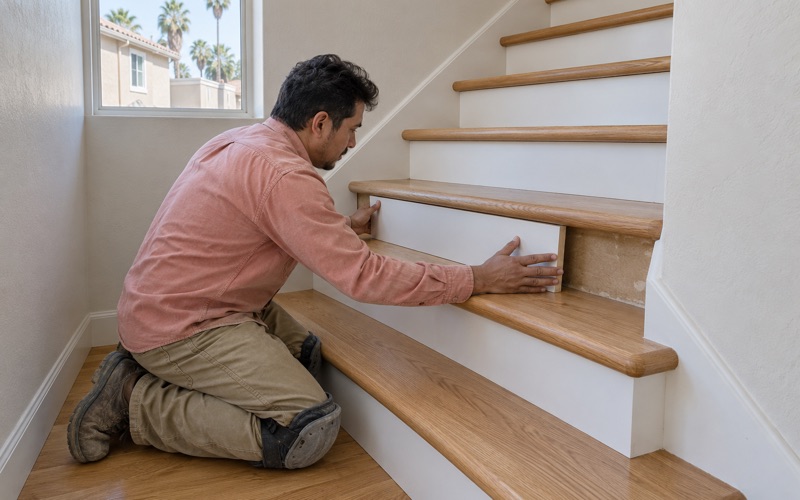
Compton Wood Flooring has spent more than 20 years on wood flooring in Willowbrook and the neighborhoods around our hub, and much of that work is shaped by who owns the building and who lives in it. Where a unit changes hands every few years and the owner answers to a program, a floor is judged on how many tenancies it survives and how cheaply one bad spot can be put right.
That changes what we recommend. We lean toward species, finishes and installation methods that let a damaged area be cut out and rewoven without touching the rest of the room, and we write down what we did in a form a property manager can file. The goal is a floor that stays in service, not one that looks its best for a single move-in.
This page covers how we approach floors in apartment buildings, County-managed developments and other income-restricted housing, where schedules, documentation and occupied units all shape the job. It also covers the older buildings in the area, where what sits under the floor matters as much as the floor itself.
Floors in Willowbrook’s Income-Restricted Housing
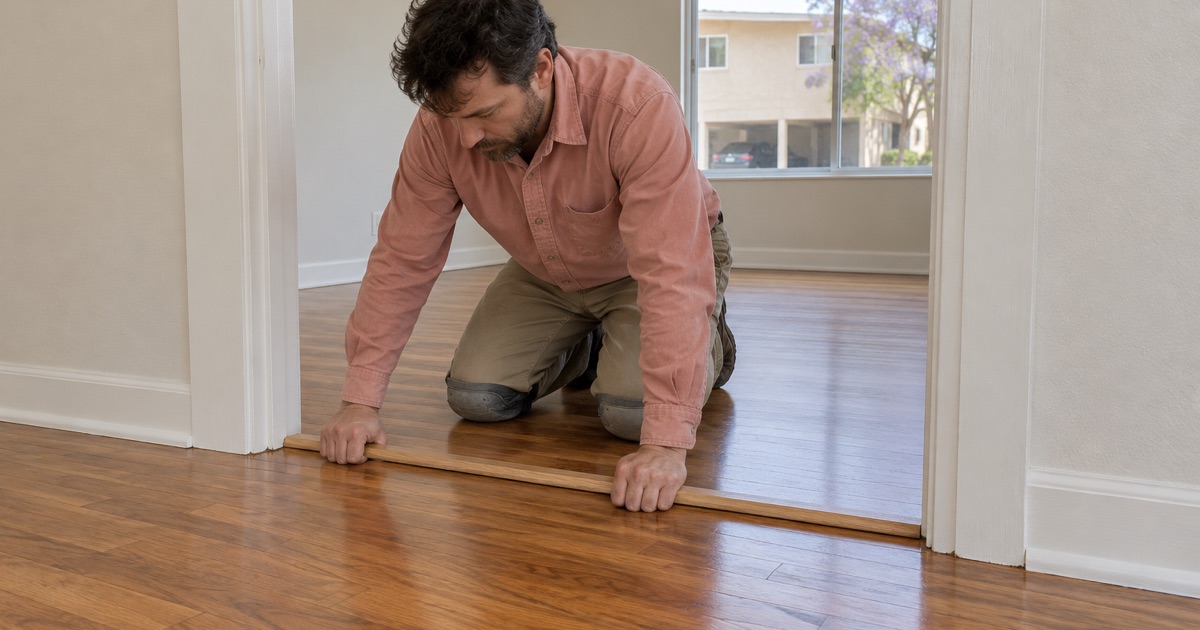
Renting is the majority arrangement here. Census counts put 57.2 percent of Willowbrook’s occupied units in renter hands, and a meaningful share of those rentals sit in buildings with affordability terms attached. Developments such as Ashley Willowbrook and Mosaic Gardens at Willowbrook carry restricted rents, and Gateway at Willowbrook adds 105 affordable senior units alongside a County library branch.
The County itself is an active owner and funder in the area. Its FY 2023-24 annual report counts 14 CDBG projects serving the broader County community of Willowbrook, and one of the listed items is improvements in County housing developments. Across the county, LACDA operates more than 3,000 public and affordable rental units, so floor decisions in this kind of housing are rarely one-off purchases.
More supply is on the way. The Seaglass Affordable Housing Project on Willowbrook Avenue is slated to provide 50 one-bedroom apartments for residents earning at or below 30 percent of area median income. For flooring, the point is simple: buildings like these are meant to house people at low rents for decades, and the floor has to be specified with that horizon in mind.
Tenancies here also tend to run long. Of the renter households the Census counted, 1,818 moved in between 2010 and 2017, far more than in any other period. A floor in a unit like that takes years of uninterrupted daily wear before anyone gets a vacant window to sand or recoat it, so durability has to be built in at the start.
Why the Building’s Age Matters Too
Newer projects are only part of the picture. By Census figures, 68.0 percent of Willowbrook’s housing units were built before 1980, which puts most of the stock inside the pre-1978 window where lead paint is a working assumption. We follow the EPA Renovation, Repair and Painting rule on that housing, containing dust from sanding, trim removal and threshold work.
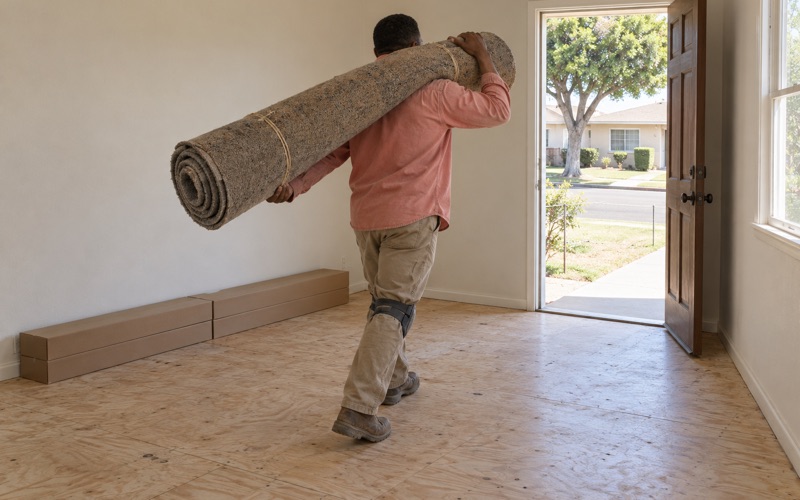
Older buildings also bring older layers underneath. When we find 9x9 tile or black mastic under a floor we are about to remove, we treat it as a possible asbestos question and stop until an asbestos survey answers it. Nothing gets scraped or sanded on a guess, which protects tenants in neighboring units as well as our own crew.
Looking for wood-flooring closer to West Rancho Dominguez? See West Rancho Dominguez Wood-Flooring.
Specifying a Floor for Long Service Between Turnovers
A managed building asks different things of a floor than a single owner does. Traffic is steady, move-outs bring furniture scrapes and dragged appliances, and the budget for each turnover is fixed in advance. We start with hardness and wear allowance, because those two numbers decide how many cycles of wear and refinishing a floor can absorb before replacement.
Species and Wear Layer
The Janka hardness rating is a fair first filter. White oak and red oak hold up well to everyday traffic and take stain predictably, while hickory resists dents harder still. On engineered products, wear layer thickness matters more than the brand name, since a thin veneer may allow only one light sanding before the core shows.
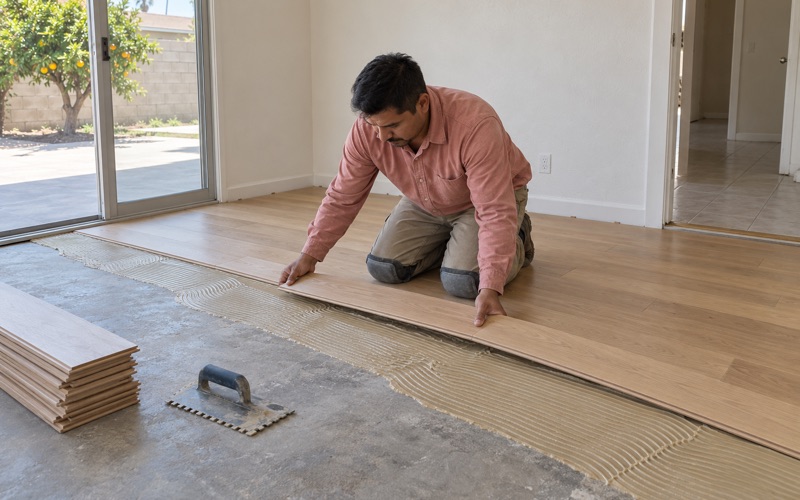
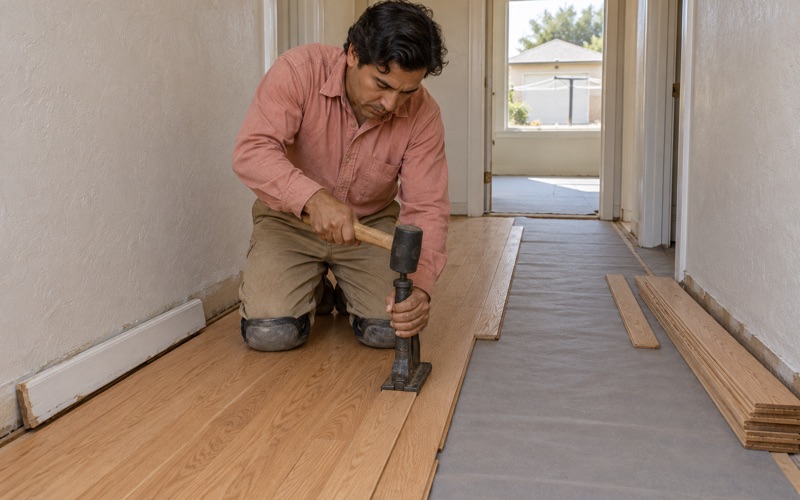
Solid strip flooring nailed down over a sound subfloor gives the most sanding cycles of anything we install. For an owner who expects to refinish between several tenancies over twenty or thirty years, that extra material is often the cheaper choice once the full service life is counted rather than just the first invoice.
Moisture and Acclimation Before Ordering
A long-service floor starts with dry conditions. We check moisture content in the wood and in any concrete it will sit over before material is ordered, using an ASTM F2170 in-situ relative humidity test on concrete where the product calls for it. The readings go on paper with the date, so the owner has a baseline for later.
Delivered flooring then needs time to acclimate to the building. Rushing that step to meet a move-in date is how gaps open in winter and boards crown in summer, and in a managed building those failures surface as work orders. We follow NWFA installation guidelines on acclimation and expansion gaps, and we build that time into the turnover schedule.
Finishes That Hold Up and Stay Legal
Finish choice drives how often a floor needs attention. We use waterborne and oil-modified polyurethanes that meet SCAQMD Rule 1113, which caps wood coatings at 275 g/L of volatile organic compounds in the South Coast air basin. A lower-odor waterborne coat also matters in occupied buildings, where neighbors share walls and hallways.
Sheen is a practical decision too. A satin or matte finish hides the fine scratches that pile up between tenants far better than gloss, and it makes a screen and recoat blend in more easily. We would rather recoat a worn but intact finish on schedule than wait until bare wood shows and the whole room must be sanded.
Repairable Before Replaceable
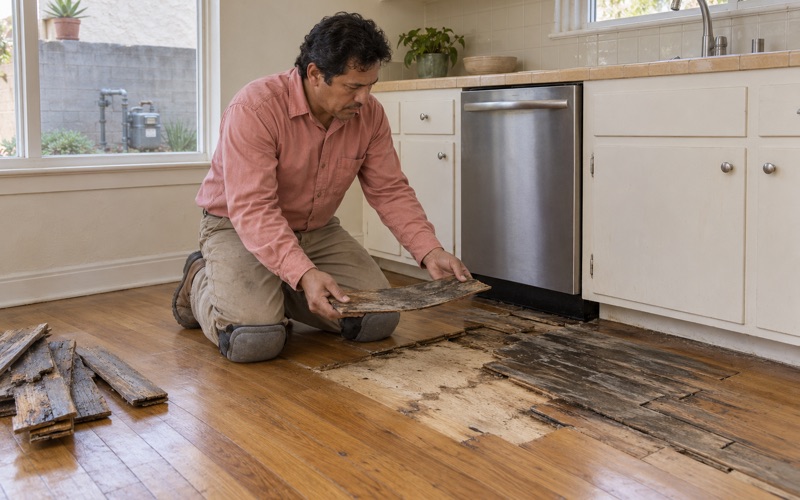
In rental housing, most floor damage is local: a leak under a sink, a burn by a heater, a gouge at a doorway. A floor that can be repaired board by board costs far less over its life than one that must be torn out whenever a section fails. We plan installations so a future repair is realistic.
Board Replacement and Weave-In Repair
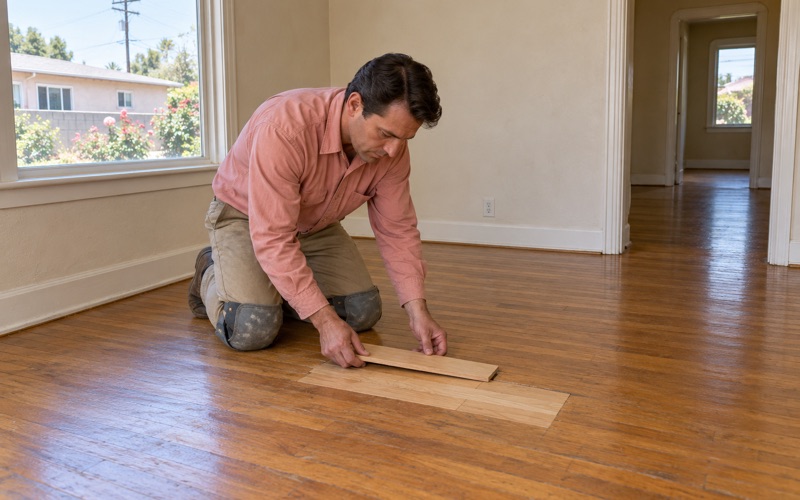
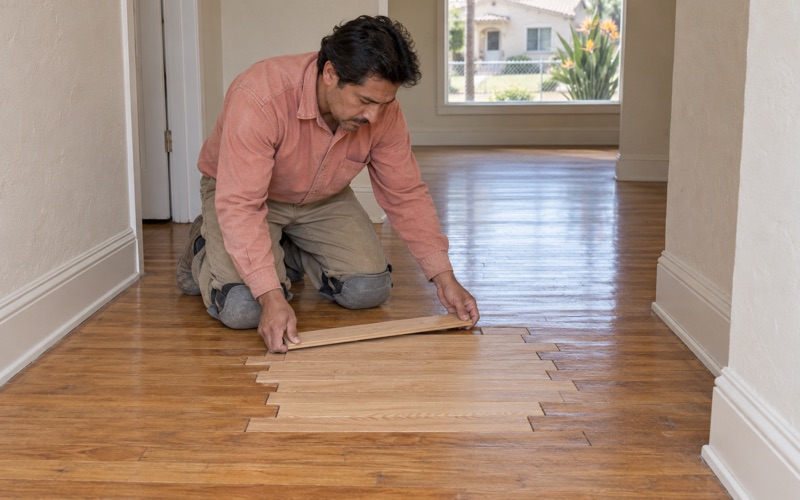
For nail-down strip floors, we cut out damaged boards and weave new ones in, staggering the joints so the patch disappears into the pattern. Matching species, width and stain is part of the job, and we note the product and color used so the next repair matches too. That record saves guesswork years later.
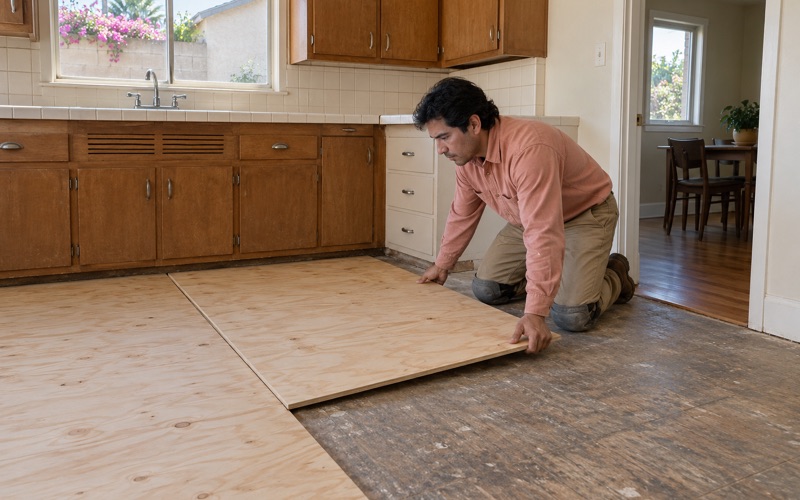
We also look at why the damage happened before we patch it. Cupping or buckling near a kitchen usually points to a slow leak, and we take readings with a wood moisture meter to find the edge of the wet area. Replacing boards over a source that is still wet only buys a few months.
Keeping Spare Stock
One habit we recommend to every operator is keeping a few boxes of the installed flooring on site. Products get discontinued and dye lots drift, so a match that is easy this year may be impossible in five. Stored flat and dry in the building, spare boards turn a large repair into a small, quick one.
Recoating Between Tenancies
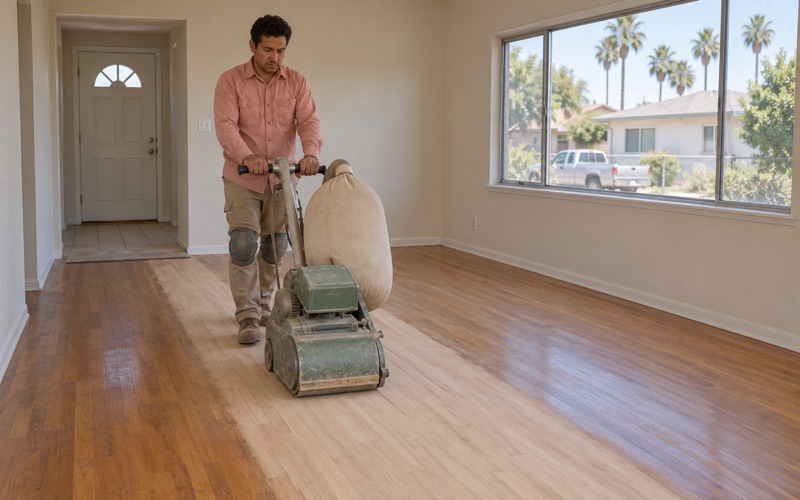
Not every turnover needs a full sanding. When the finish is scratched but still intact, a screen and recoat abrades the top coat and adds fresh polyurethane in a day or two, without taking any wood off. Done on a regular cycle, it preserves the wear layer so a full refinish is saved for when it is truly needed.
We tell owners plainly which option a unit needs. If gray, worn traffic lanes show bare wood, a recoat will not bond there and the floor needs sanding through a proper grit sequence. If the finish is merely dull, recoating is the cheaper and faster answer, and it keeps the unit off the vacancy list for less time.
Records, Schedules and Occupied Buildings
Owners of regulated housing answer to lenders, program monitors and inspectors, and each of them asks for paper. We provide written estimates and invoices that list the rooms, the materials and the scope, in a format a landlord can keep with the unit file or show before a housing-voucher inspection. Moisture readings are written down with the date and location.
What Goes in the File
For each job we can record the species and product, finish brand and sheen, square footage by room, and any repair areas marked on a simple sketch. On pre-1978 housing we note the lead-safe practices used. That set of documents helps the next contractor, answers questions from an asset manager and supports a claim if water damage returns.
For engineered and other composite products, we keep the labeling that shows the material is CARB Phase 2 compliant and meets TSCA Title VI formaldehyde limits. Owners of subsidized buildings are often asked what went into a unit, and having the product sheet in the file answers that question in minutes instead of days.
Those records matter for owners of market-rate buildings too. Los Angeles County’s rent stabilization ordinance, administered by DCBA, covers many unincorporated rental properties with two or more units, and DCBA runs a Rent Registry where owners register them. A clean paper trail on capital work is simply good practice for anyone managing units under County rules.
Working Around Tenants
Most of our managed-housing work happens with neighbors at home, so scheduling matters as much as technique. We sequence units so a vacant one is finished during turnover, keep dust controlled with a dustless sanding system, and plan cure times around move-in dates. When a hallway or common room needs work, we phase it so residents keep a way through.
We also give managers clear notice of what residents will notice. That means the hours the sanders will run, how long a finished floor must cure before furniture returns, and when windows should stay open for ventilation. Written notices posted in advance cut down on calls to the office and keep a multi-unit job moving on schedule.
Willowbrook is an unincorporated area governed by the Los Angeles County Board of Supervisors, in Supervisorial District 2, and the County’s Southwest Building and Safety Office on Imperial Highway is the local field office. We coordinate timing with property managers from the start, so the floor is one fewer thing standing between a vacant unit and the next household.
- 20+ Years of Wood Flooring
- Written Scopes and Estimates
- Free Estimates