Compton Wood Flooring brings more than 20 years in the trade to wood-flooring in Watts, and most of that work happens in houses that were already old when we first walked through the door. We refinish, repair, patch and replace hardwood, and we plan each job around what an older floor usually hides: past patches, worn finish and layers of covering.
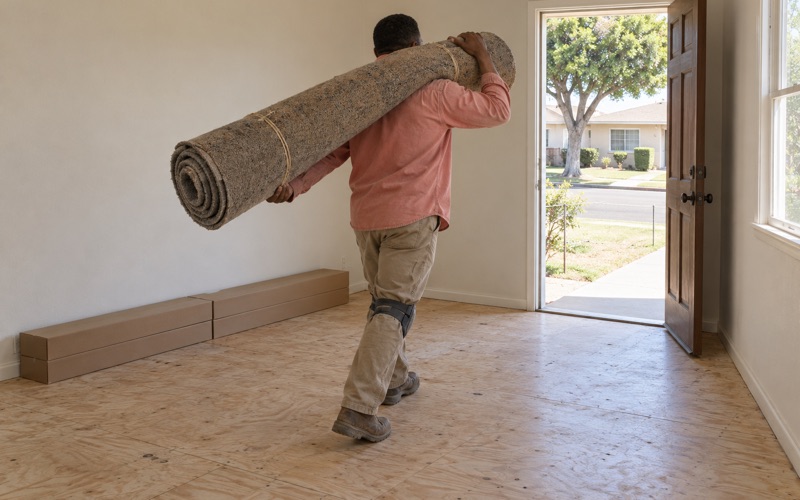
Much of what we find starts under wall-to-wall carpet, sheet linoleum or a coat of paint. Before anyone talks about tearing a floor out, we lift a corner, read the boards one at a time and decide what can be saved. A sound floor that only looks tired is usually cheaper to sand than to replace, and we say so in writing.
This page is about one kind of house in particular: the homes built in Watts during the 1940s, when the neighborhood grew fast. Their floors are now about 80 years old, and they tend to need the same few decisions. Below we cover where those houses sit, what their floors usually need and how we choose between refinishing, patching and replacement.
Watts in the War Years and the Homes They Left
A Wartime Population Boom
The Watts Neighborhood Council hosts a community history, A Brief History of Watts, California, that describes a 1940s-1960s period in the neighborhood’s life. After the Great Depression, it says, several manufacturing plants were built in Watts to help produce weapons and machinery for World War II. The war brought new economic opportunities and, in the history’s words, created a population boom.
A population boom needs somewhere to live, and the housing counts for the area carry that layer plainly. The history does not name which plants were built or which blocks of houses followed them, so we do not either. What it does establish is the decade, and the decade is what matters most when we are standing on one of these floors.
What the ZIP Code Counts Show
Census housing tables are published by ZIP Code Tabulation Area rather than by neighborhood, and neither of the two ZIP codes that serve Watts matches its boundary exactly. Even so, the pattern is clear. In ZIP 90059, 2,386 of 10,654 homes were built between 1940 and 1949, the largest single year-built group in that ZIP code.
ZIP 90002 tells a similar story at a larger scale. There, 2,919 of 13,662 homes, or 21.4 percent, date to the 1940s, and another 1,998 were built in the 1950s. ZIP 90059 adds 2,001 homes from the 1950s on top of its 1940s layer. Both codes also reach into areas outside Watts, so these are ZIP figures, not neighborhood totals.
Owners, Renters and Who Calls Us
Ownership shapes how a floor job is scoped. In ZIP 90059, 4,560 of 10,314 occupied homes are owner-occupied, or 44.2 percent, which means more than half are rented. An owner living in the house usually wants a floor that lasts another few decades, and we work for both sides of that split, with the paperwork each one needs.
Landlords often call between tenants, when a unit is empty for a short window and the floor has to be ready for a move-in or a housing-voucher inspection. For those jobs we write estimates and invoices that itemize each room, so the record can back up a Civil Code 1950.5 security deposit accounting or show an inspector exactly what was done.
Looking for wood-flooring closer to Paramount? See Paramount Wood-Flooring.
Where Watts Runs: 92nd Street to Imperial Highway
Ten Areas on the Council Map
The Watts Neighborhood Council’s district map draws the neighborhood between East 92nd Street on the north and East Imperial Highway on the south, with Alameda Street to the east and Central Avenue and Success Avenue to the west. Inside that line it marks ten numbered areas, divided by streets such as 103rd Street, Century Boulevard and Wilmington Avenue.
The map is a civic document, not a housing survey. It names no residential tracts and no build dates, so it cannot tell anyone which block holds 1940s houses. It helps us for a simpler reason: when a customer tells us which council area they live in, we know where we are headed and which part of the neighborhood we are working in.
From Rancho Land to Rail Suburb
The same community history traces Watts back to Rancho La Tajauta, a 3,560-acre land grant made in 1843. The area stayed mostly farmland until the Pacific Electric Railway opened in 1902, after which the rancho was sold off and subdivided into smaller farms and home lots. The neighborhood covers only about 2.1 square miles today.
One reminder of the rail era still stands. Watts Station, built in 1904, is Los Angeles Historic-Cultural Monument No. 36 and is listed on the National Register. The station is a public landmark rather than a house, and it has nothing to do with residential floors, but it marks how long this part of Los Angeles has been settled.
Inside Los Angeles, Not Compton
Watts is a Los Angeles neighborhood, not a separate city, and has been since its annexation took effect on June 1, 1926. That means the city departments involved with a Watts property are City of Los Angeles offices rather than Compton’s. We keep that straight whenever a job calls for paperwork, so an owner is never sent to the wrong counter.
What an 80-Year-Old Floor Needs
What Hides Under the Covering
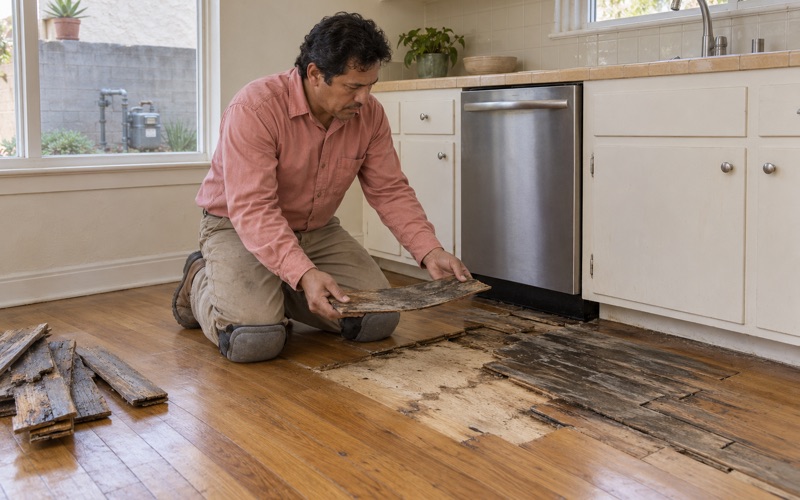
A floor from the 1940s has usually been covered, repaired or refinished several times, and its history is written in the layers. Carpet tack strip leaves rows of nail holes along the walls. Linoleum and its adhesive can bond to the wood, and paint that crept under a baseboard can sit deep in the grain. We take stock of all of it before we quote.
We also look for what the house changed over the years. A rectangular patch in a hallway may mark an old floor furnace opening, a newer strip at a doorway may mark a removed wall, and a different board width in one room may be a later repair. None of that ends a floor’s life, but each one changes how we sand and patch it.
We never assume what species is underneath until we see it. A board’s Janka hardness rating affects how aggressively it can be sanded and how it takes stain, so we identify the wood in each room before we pick a grit sequence or a color. Where a later repair used a different species, we plan for how the two will look side by side.
Moisture, Framing and Bounce
Eight decades of use can loosen what holds a floor down. Squeaks, nail pops and board gaps are common, and so are soft spots near kitchens and bathrooms where water got in at some point. We read moisture content with a wood moisture meter in several places and write the numbers down, so the decision about each room rests on a measurement.
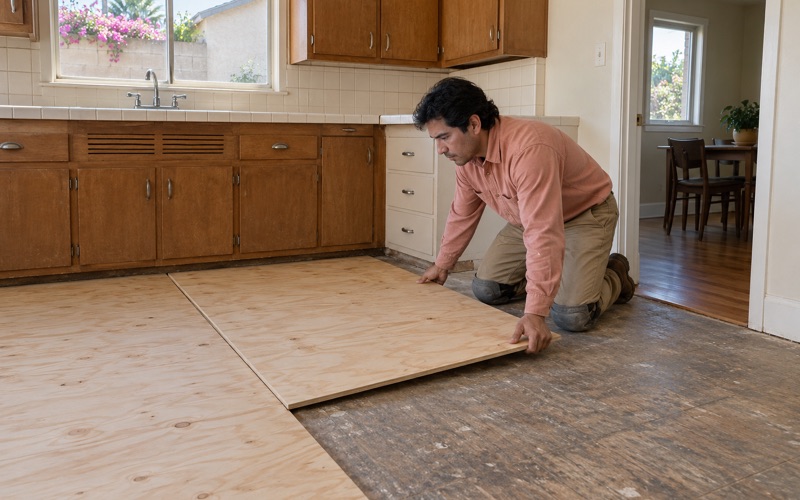
When a floor slopes, bounces or dips, the cause usually sits below the finish boards rather than in them. We trace it to the subfloor and the framing before we price anything, checking for a sagging joist, damaged sheathing or old termite damage such as frass and kick-out holes. Joist sistering or subfloor repair comes first when the structure needs it.
If any room in the house sits on concrete, we test that slab too, using a calcium chloride moisture test or an ASTM F2170 in-situ relative humidity test depending on the job. New boards acclimate in the house before installation, and we follow NWFA installation guidelines for expansion gaps and fastening. The readings go into the written scope alongside the price.
Old Tile, Mastic and Lead Paint
Houses of this age often carry flooring layers that deserve caution. Old 9x9 tile and the black mastic beneath it can contain asbestos, so we treat both as an open question and recommend an asbestos survey before anything is sanded, scraped or ground. SCAQMD Rule 1403 governs how asbestos-containing material is handled in this region once it is confirmed.
Lead paint is the other concern. In ZIP 90002, 75.5 percent of homes were built before 1980, so lead-safe work rules apply to most of the jobs we do there. On pre-1978 housing we follow the work practices of the EPA Renovation, Repair and Painting rule, containing dust around baseboards, trim and painted floor edges and cleaning up before furniture goes back.
Refinish, Patch or Replace a Wartime Floor
When a Full Sanding Is Enough
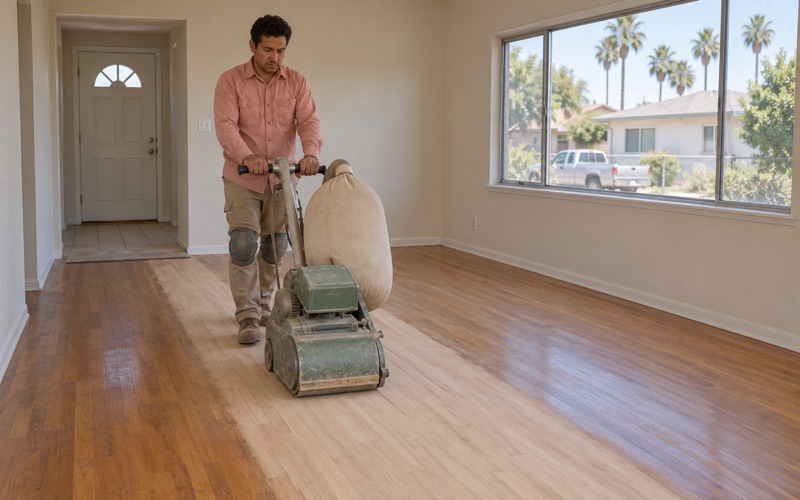
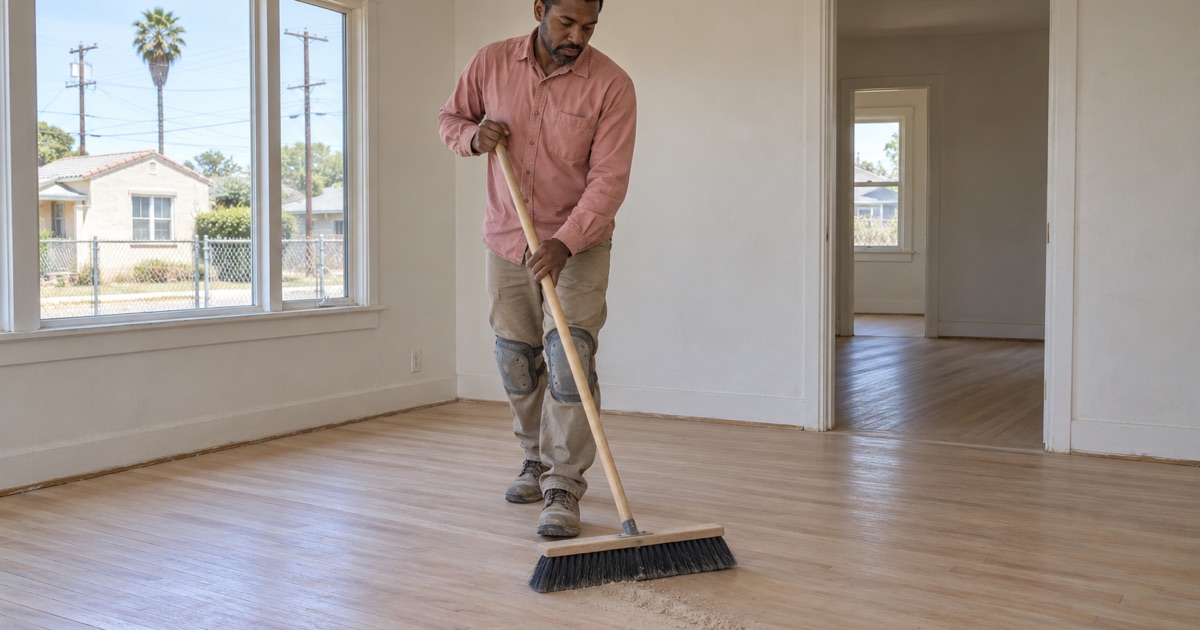
If the boards are sound and enough wood remains above the tongue, a full sanding usually brings an old floor back. We work with a drum sander, an edger and an orbital sander connected to a dustless sanding system, stepping through the grit sequence until the old finish, wax buildup and surface stains are gone. Deep pet urine stains may still call for board replacement.
Not every tired floor needs bare wood. Where the finish is worn but intact and carries no wax, a screen and recoat adds a fresh coat of polyurethane for a fraction of the cost and time. We test adhesion first, because a new coat laid over a contaminated surface can end up peeling or tacky within weeks.
Finishes That Meet South Coast Rules
Watts lies inside the South Coast Air Quality Management District, which limits the volatile organic content of wood finishes. Under SCAQMD Rule 1113 the wood-coatings limit is 275 grams per liter, and every finish we apply here is chosen from products that meet it. Within that limit, homeowners still choose between waterborne polyurethane, oil-modified polyurethane and hardwax oil.
Each finish ages differently. Waterborne products stay closer to the natural color of the wood, while oil-modified ones deepen toward amber over time, which is part of why some older floors read as orange oak. We show samples on the actual boards and let customers pick a sheen level before we coat a whole room.
Patching Holes and Weaving In Boards
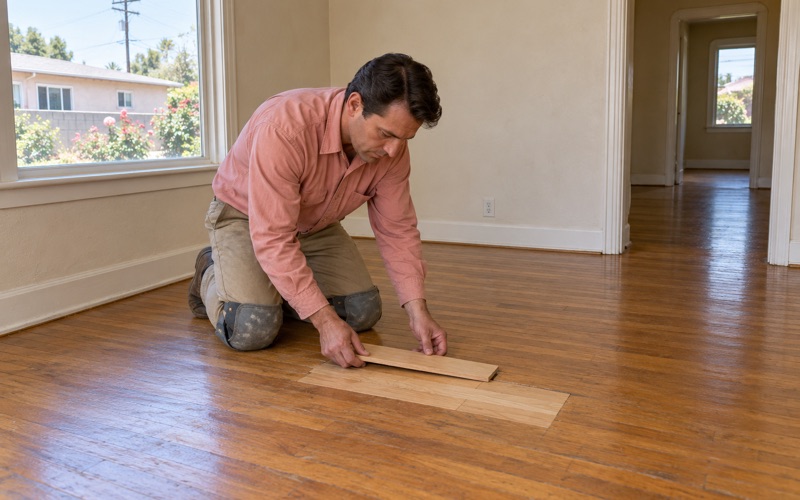
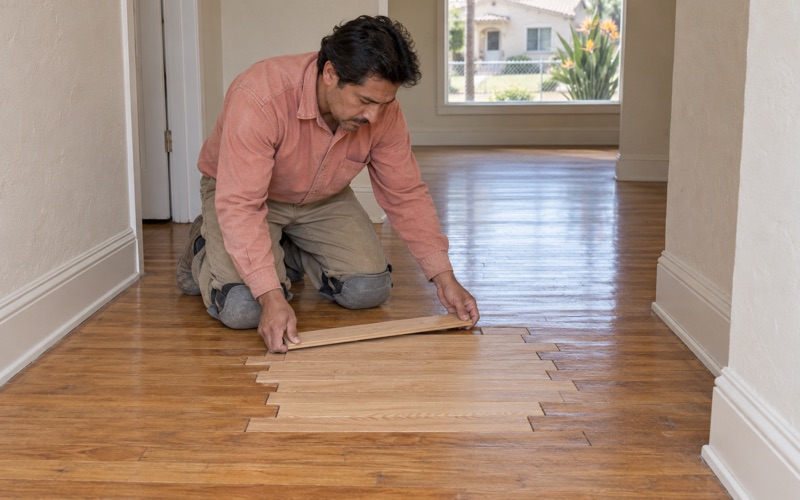
Where a floor furnace once sat, or a wall was removed, a plywood square and a rug is the fast fix and the wrong one. We frame the opening properly, then weave new boards into the surrounding floor so the joints stagger the way the original layout runs. Once sanded and finished together, the repair reads as part of the floor rather than a lid over a hole.
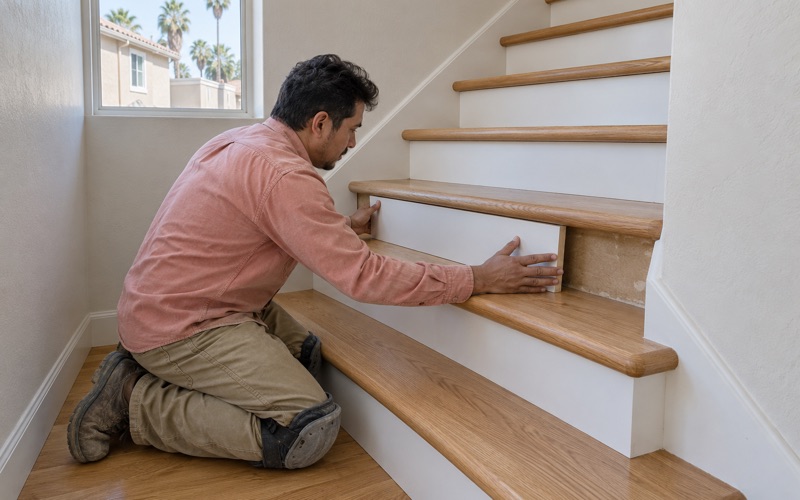
The same weave-in repair handles water-stained or split boards and damage left by old pests. We match board width and, where possible, species, and we fasten new strips with the right cleat nail or flooring staple for the job. Stairs are priced separately, per tread and riser, so a customer can see what the stair nosing and each step cost.
When Replacement Makes Sense
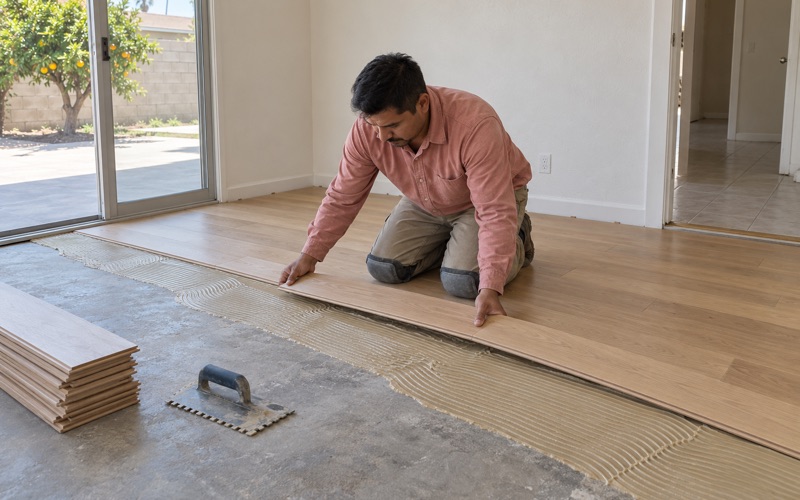
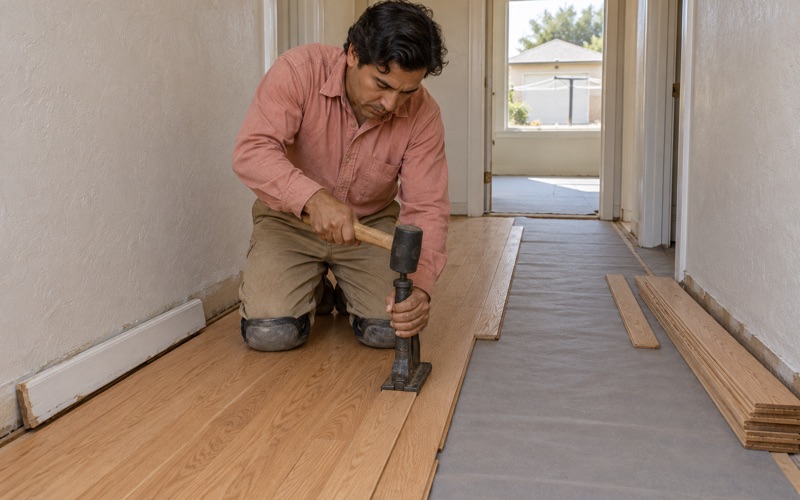
Some floors have been sanded too many times, or the damage runs across too many boards to patch. In those cases we lay out the choices plainly: solid white oak or red oak strip, a harder species such as hickory, or an engineered floor whose wear layer thickness and core construction suit the room. Nail-down, glue-down and floating installation each fit different conditions.
Whatever the answer, we put the scope, measurements and moisture readings in writing before work begins. Owners get a record they can keep with the house, and landlords get itemized paperwork for their files. On a wartime floor in Watts, the best outcome is often keeping as much of the original wood as the structure allows and repairing the rest with care.
- 20+ Years of Wood Flooring
- Written Scopes and Estimates
- Free Estimates