
Compton Wood Flooring handles water damaged hardwood floor repair for homes in Compton, CA, serving surrounding cities including East Rancho Dominguez, Willowbrook, West Rancho Dominguez, Lynwood and Watts, with more than 20 years of hands-on wood floor work. The calls we get usually follow the same pattern: a supply line under a sink let go, a water heater in a hallway closet finally failed, or a dishwasher leaked quietly until the boards in front of it began to lift. Every one of those is a different repair, and the first step is always the same: find where the water came from and where it went.
Wood floors hold water in ways that are easy to miss. The surface can look dry while the subfloor underneath is still soaked, and a floor sanded or covered too soon locks that moisture in. We measure moisture content in the boards and the subfloor with a wood moisture meter, map the wet area, and write every reading down, so the repair plan rests on numbers rather than a guess about how long to wait.
Those same readings, together with photos and a clear note of the source, are what an insurance adjuster needs to review a claim. We build that record from the first visit, whether or not you end up filing, so the evidence exists if you need it later.
Finding the Source and Measuring the Damage
Tracing Where the Water Came From
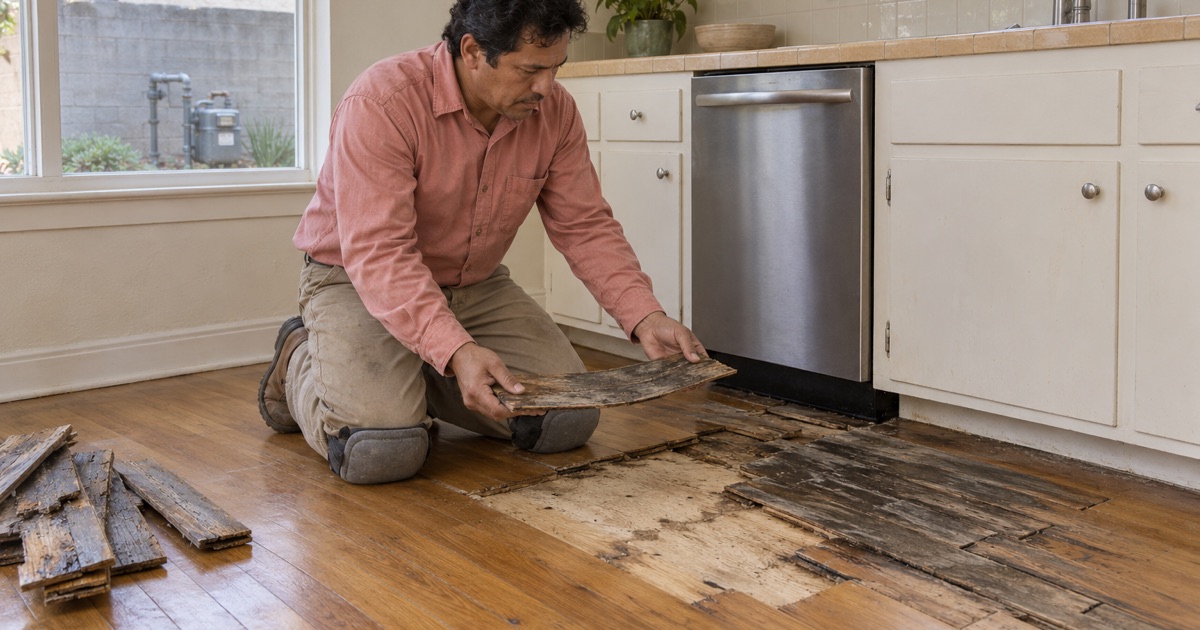
Water travels along joists, under baseboards and through subfloor seams, so the wettest board is not always next to the leak. We follow the moisture pattern back to the source, checking supply lines, drains, water heaters, appliance hoses and the crawlspace underneath. Until the source is repaired by a plumber or appliance tech, any floor repair is temporary.
In raised-foundation houses, we also look below. Standing water or damp soil in a crawlspace can keep a floor wet from underneath long after the plumbing is fixed, and poor crawlspace ventilation slows the whole drying process. Those conditions go into the scope, because they decide how quickly the floor can be repaired.
Moisture Mapping the Floor
We take readings in a grid across the affected area and into dry parts of the same floor for comparison. That shows exactly which boards are wet, how far the water spread and whether the subfloor is wetter than the finish floor. We record each reading with its location and date, and repeat them as the floor dries.
The dry-area readings matter as much as the wet ones. They tell us what normal looks like in your house, which is the target the damaged area has to return to before sanding, refinishing or replacing anything.
Reading Cupping, Crowning and Buckling
Cupping means the board edges are higher than the centers, because the bottom of the board took on more water than the top. Buckling means boards swelled so much they lifted off the subfloor. Crowning, where the center is higher, often shows up when a cupped floor is sanded before it has dried. Each shape tells us something about how the water moved and what the repair needs.
We photograph each of those shapes before anything is touched, with a straightedge laid across the boards so the cupping shows clearly in the picture. Once a floor has dried and flattened, that evidence is gone, and a claim reviewed weeks later has only the photos to go on.
Drying and Saving What Can Be Saved
Drying the Floor and Subfloor
Once the source is stopped, we remove whatever traps moisture, such as rugs, pad or sometimes a few boards, and let air move across and under the floor. In a crawlspace, drying from below can speed the process considerably. Many cupped floors settle back close to flat once moisture content returns to normal.
We do not set a drying time in advance. We check the readings on a schedule and only move to the next step when the wet area matches the dry reference readings. Sanding a floor even slightly early is the most common way a salvageable floor ends up needing replacement.
Deciding Which Boards to Replace
Boards that split, delaminated, grew mold or turned deeply black usually have to come out. Boards that only cupped and dried back flat can usually stay. We mark each one and explain the decision, so you only pay to replace wood that actually failed.
On older oak strip floors, the replacement wood has to match in species, width and thickness. We weave new boards into the existing floor with staggered joints, which keeps the repair from showing up as a square patch once the room is refinished.
Subfloor Repairs Under Wet Hardwood
When the subfloor has swelled, delaminated or started to rot, it has to be repaired before the finish floor goes back. We cut out the damaged plywood subfloor or board subfloor back to the joists, replace it and check the framing underneath. A soft subfloor under a new floor produces the same soft spot again within a year or two.
Refinishing and Replacing After Water Damage
Sanding and Refinishing a Dried Floor
Once the floor is dry and any bad boards are replaced, we sand the area or the whole room flat and apply new finish. Sanding the whole room usually gives the most even result, since the repaired area otherwise stands out against older, aged finish. We use waterborne or oil-modified polyurethane that meets the South Coast 275 g/L wood-coating limit.
Replacing Engineered or Prefinished Floors
Engineered floors with a thin wear layer or a fiberboard core often cannot be dried and sanded back the way solid wood can. When they are damaged, we replace the affected boards with the same product if it is still available. If it is not, the scope says so clearly, since mismatched flooring can affect how a claim is settled.
Where the whole floor has to be replaced, we test the slab or subfloor moisture again before installing anything new, using an ASTM F2170 test on concrete or a meter on wood. A new floor installed on a substrate that is still wet repeats the damage.
Documentation for Insurance Claims
What We Record on Every Water Job
For each job we record the source of the water, the date it was found, photos of the damaged floor and any opened subfloor, moisture readings with locations, and a written repair scope. That package gives your adjuster a clear picture of cause, extent and cost, and it speeds up a review that otherwise stalls waiting for information.
Matching and Uniform Appearance
When a repair would leave new boards next to old ones that do not match, we note it in the scope. California’s claims standards under 10 CCR 2695.9 address replacement that leaves a reasonably uniform appearance, and the adjuster decides how that applies. Our job is to give them accurate information to decide with.
Rentals and Water Damage
For rental properties, we document the damage and repair with itemized invoices a landlord can keep with the unit’s records. That helps show what was repaired, when, and why, which can matter later at move-out or during a housing inspection.
A wet floor in an occupied rental also raises habitability questions under California Civil Code 1941.1, so landlords usually want the repair scheduled quickly. We coordinate access with the tenant, keep the work area contained, and give the owner a completion record once the floor is dry, repaired and refinished.
- 20+ Years of Wood Flooring
- Written Scopes and Estimates
- Free Estimates