
Compton Wood Flooring installs solid hardwood flooring in Compton, CA, serving surrounding cities including East Rancho Dominguez, Willowbrook, West Rancho Dominguez, Lynwood and Watts, and we have been putting down and caring for wood floors for more than 20 years. Solid hardwood is milled from single pieces of wood, usually three-quarters of an inch thick, and it is the floor most older Compton houses were built with. It can be sanded and refinished many times, which is why a well-installed solid floor often outlasts everything else in the house.
Solid wood is at its best on a raised foundation, nailed to a plywood or board subfloor over joists. That describes a large share of Compton homes, and it is where we recommend solid most often. On slab-on-grade houses and additions, where concrete moisture is a constant, we usually point you to engineered hardwood instead and explain why.
The floor is only as good as what is under it, so every solid hardwood quote starts in the crawlspace. We check the joists, the subfloor and the moisture level before any wood is ordered, and we price the finish floor only after we know the base is sound.
Wood Species and Hardness
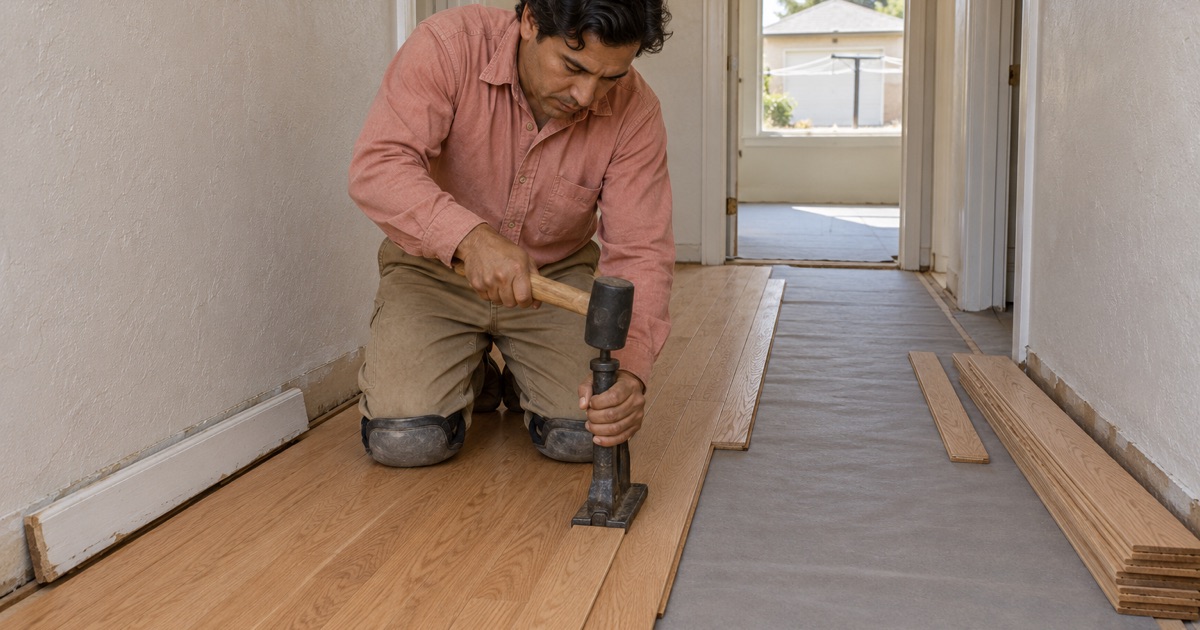
Red Oak Solid Flooring
Red oak is the most common solid hardwood in American homes and the species most often found under old carpet in Compton. It has a warm, slightly pink tone, an open grain that takes stain readily, and it blends easily with existing oak floors when a new room is added. For houses where new floor has to meet original floor, red oak is often the natural choice.
Red oak is also forgiving to refinish. Its open grain hides minor scratches and wear better than smoother species, and it responds predictably to the full range of stain colors. The one caution is that it can turn amber under some oil-based finishes, so we talk through finish choice at the same time as species.
White Oak Floors
White oak is a little harder than red oak on the Janka scale and has a tighter, more even grain with less pink in it. It takes gray, natural and brown stains cleanly, which is why it dominates current design trends. White oak also resists moisture somewhat better than red oak, a real advantage near kitchens and entries.
Hickory and Harder Species
Hickory rates harder than both oaks and has dramatic color variation from pale to dark brown within the same board. It holds up well to dogs, kids and heavy furniture, though its strong character is not for every room. We bring full-length samples so you can judge the variation before committing.
Board Width and Layout
Strip Flooring
Narrow strip flooring is the classic look in older houses. Narrow boards move less with changes in humidity, so strip floors stay tight and flat. When a new room has to match an original oak strip floor, we match the width exactly so the transition disappears.
Wide Plank Solid Floors
Wide plank solid flooring shows more grain in each board and makes rooms feel more open, but wide boards expand and contract more across their width. Those planks need careful moisture control, correct fastening and sometimes a glue assist to stay flat. We explain the risks before recommending wide solid plank and suggest engineered where conditions are borderline.
Herringbone and Patterned Layouts
Herringbone and chevron patterns are laid from a center line with every board cut and fitted by hand. They take more labor and more material than straight-lay floors, but they turn an ordinary room into a feature. We lay out the pattern on paper first so it lands square at the walls and centered on the main doorway.
Patterned floors also need a flatter subfloor than a straight-lay floor, since short, angled boards show every dip. We usually glue and nail herringbone to plywood, and we plan a border or a straight-laid frame at the walls so the pattern ends cleanly instead of in slivers.
Installation Over Raised Foundations
Checking the Subfloor First
Solid hardwood should be nailed to a flat, stiff, dry subfloor. We check for loose or damaged boards, soft spots near plumbing and dips from sagging joists, and we repair them before any flooring goes down. In many older homes we add plywood underlayment over the original board subfloor for a flatter, quieter base.
Where old flooring has to come out first, we check what it is before tearing into it. Old 9x9 tile or black mastic in a house of this age is treated as a possible asbestos question, and an asbestos survey comes before any scraping, so the removal follows SCAQMD Rule 1403 rather than spreading fibers through the house.
Acclimation and Moisture Content
New wood brought into a house takes on or gives up moisture until it matches its surroundings. We measure the moisture content of the flooring and the subfloor with a wood moisture meter and install only when the difference falls within the range NWFA installation guidelines and the manufacturer allow. Installing too wet or too dry is a leading cause of gaps and cupping later.
Nail-Down Fastening and Expansion Gaps
Solid floors are blind-nailed through the tongue with a cleat nail or flooring staple at the spacing the manufacturer specifies. We leave an expansion gap around the perimeter, hidden under baseboard or shoe molding, so the floor has room to move with the seasons. A floor installed tight to the walls can buckle once humidity rises.
Finishing Solid Hardwood
Site-Finished Solid Floors
Unfinished solid flooring is sanded flat after installation, stained if you want color, and finished in place. The finish seals across every seam, which gives a smooth surface and a uniform look. All finishes we apply meet the South Coast air district’s 275 g/L VOC limit for wood coatings.
Prefinished Solid Floors
Prefinished solid hardwood arrives with a factory-cured finish and can be used right after installation, which avoids sanding dust and finish fumes in the house. The tradeoff is a slight bevel at each board edge and less freedom to customize the color on site.
Prefinished floors can still be refinished later, since solid boards keep their full thickness above the tongue. The first sanding simply has to go a little deeper to remove the edge bevels, and from then on the floor behaves like any site-finished one.
- 20+ Years of Wood Flooring
- Written Scopes and Estimates
- Free Estimates