
Compton Wood Flooring helps homeowners replace carpet with hardwood in Compton, CA, serving surrounding cities including East Rancho Dominguez, Willowbrook, West Rancho Dominguez, Lynwood and Watts, and we have more than 20 years of wood floor work behind us. Replacing carpet in a Compton house often starts with a pleasant surprise: many homes built in the 1940s and 1950s have original oak strip flooring hiding under the carpet. Before we quote anything new, we check whether you already own a hardwood floor.
When there is no floor worth saving underneath, we install new solid or engineered hardwood. Either way, the job is less about the carpet coming up than about what the new floor sits on. Carpet and pad hide dips, soft spots and old patches that a hard floor will not tolerate, so we fix those first.
We price the whole job in writing, from carpet removal and haul-away through subfloor repairs, the new floor, transitions and trim. That lets you compare our number with anyone else’s line by line.
Look Under the Carpet First
Finding Original Hardwood
We pull back carpet at several spots in different rooms, often inside closets and at floor vents, to see what is underneath. Oak strip flooring running wall to wall is common in Compton houses of this age. If the wood is sound and thick enough to sand, refinishing it is usually faster and less expensive than a new install.
The condition of an uncovered floor varies room by room. A bedroom may be nearly perfect while a hallway was patched when an old floor furnace came out. We check each area so you know exactly which rooms can be restored and which need new wood woven in.
When the Original Floor Cannot Be Saved
Some floors have been sanded too thin, damaged by long-term pet urine or leaks, or partly replaced with plywood during a remodel. When that is the case, we show you what we found and price a new floor instead. We would rather give you a clear reason than refinish a floor that will not hold up.
Preparing the Subfloor
Removing Carpet, Pad and Tack Strip
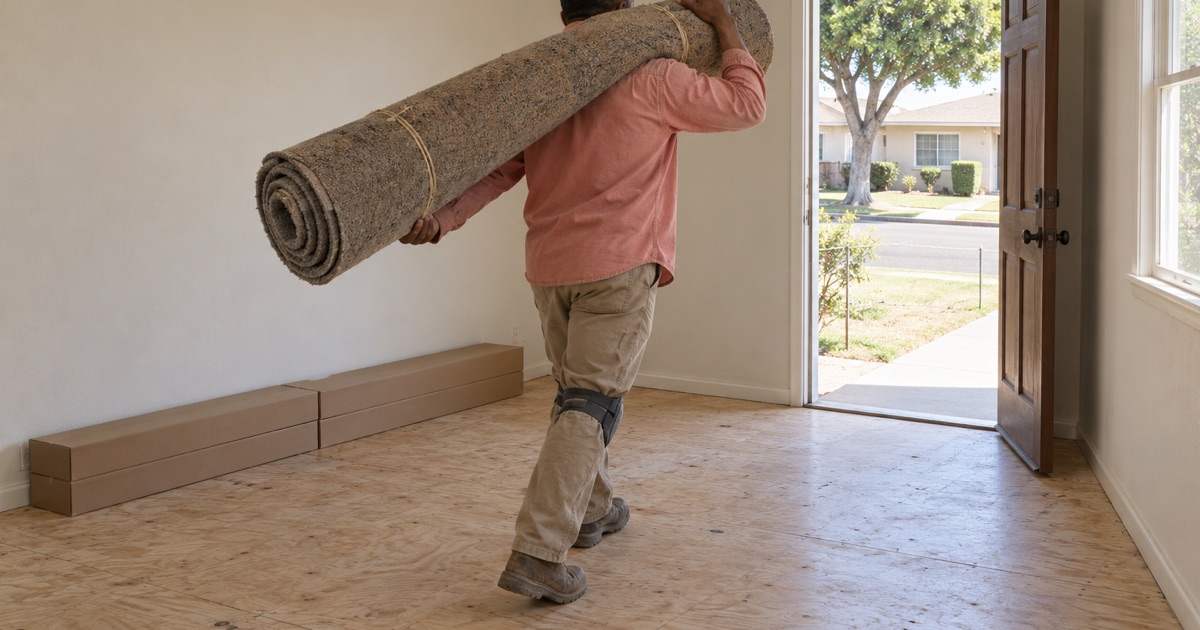
We remove the carpet and pad, pull the tack strip from every wall and remove every staple and nail left in the subfloor. Leftover fasteners push up under a new floor and create bumps and squeaks. This step is quick on a clean floor and slow on one that has been re-carpeted several times, so we check before quoting.
Fixing Soft Spots and Uneven Areas
Carpet hides a lot. Once it is up, we walk the subfloor for soft spots near bathrooms and kitchens, check flatness with a straightedge, and look for loose boards or damaged plywood. Soft areas are cut out and replaced, high spots are planed and low spots are filled, because hardwood telegraphs every flaw in the surface beneath it.
Where the floor slopes noticeably, we look at the framing under the house before going further. A sagging joist or a settled pier should be corrected before a hard floor goes over it, or the new floor will crack or gap along the same line.
Checking Moisture Before Installation
We measure the moisture content of the subfloor with a wood moisture meter, and on slab houses we test the concrete with an ASTM F2170 or calcium chloride test. Those readings go into your file and decide which product and installation method will work. A floor installed over a wet substrate is one of the most common reasons new hardwood cups in its first year.
Choosing the New Floor
Solid Hardwood Over Raised Foundations
On raised-foundation houses with a wood subfloor, solid three-quarter-inch hardwood nailed down is a durable, classic choice that can be sanded many times. Red oak, white oak and hickory are the common options, each with a different color and hardness on the Janka scale. Solid strip floors also match the original floors found elsewhere in older houses.
Engineered Hardwood Over Slabs
On slab-on-grade homes and additions, engineered hardwood is usually the better choice because its layered core resists the moisture that comes through concrete. It can be glued down or floated over a vapor retarder. We choose a wear layer thick enough to allow future sanding so the floor has a long life.
Prefinished or Sanded in Place
Prefinished boards can be used as soon as they are installed, which suits homeowners who cannot clear the house for long. Site-finished floors are sanded and coated after installation, giving a flat, sealed surface and full control over color. Finishes we use meet the South Coast 275 g/L VOC limit.
Transitions, Trim and Stairs
Doorways and Height Changes
New hardwood rarely sits at the same height as the carpet it replaces or the tile it meets. We use reducer strips, T-molding and thresholds to make each transition smooth, and we trim doors if the new floor would catch them. Getting these details right is what makes a new floor feel finished.
Baseboards and Shoe Molding
Where carpet was tucked against the baseboard, the new floor often needs shoe molding to cover the expansion gap along the walls. In pre-1978 houses, we treat old painted trim with lead-safe practices when we remove or disturb it, and we protect or replace it neatly.
Carpeted Stairs to Hardwood
Carpeted stairs can be converted to hardwood with new treads, risers and nosing that match the new floor. We price stairs per tread and riser, so the stair cost is clear rather than buried in a square-foot rate.
- 20+ Years of Wood Flooring
- Written Scopes and Estimates
- Free Estimates