Compton Wood Flooring brings more than 20 years of wood-flooring work to Los Alamitos, and most of what we are called out for here starts with water that got loose inside the house. A dishwasher line lets go, a toilet seal weeps for months, or a window left cracked during a storm soaks one corner of a bedroom. We treat each of those as a room problem, not a whole-house problem.
That approach shapes the quote from the first visit. We trace wet boards back to their source, take moisture readings in the wood and in any concrete underneath, and write the numbers down before material is ordered. When the damage stops at a doorway, the repair stops there too, and the boards we add are woven into the existing rows so the patch disappears under the finish.
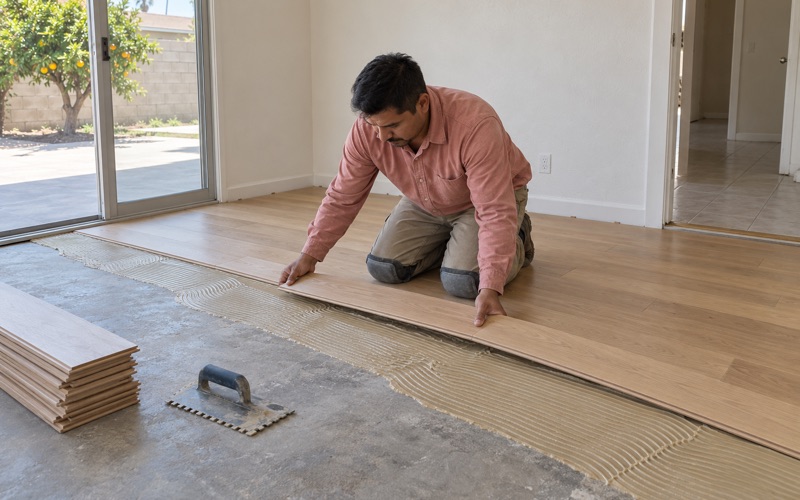
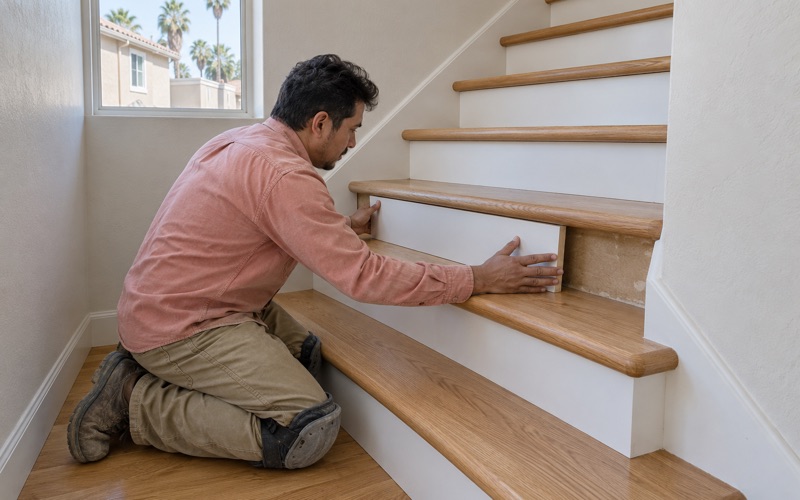
The same planning carries across the rest of the trade: sanding and refinishing, new installation, stairs and board-by-board repair. Stairs are priced per tread and riser rather than buried in a square-foot rate. Every scope we hand over is written so an owner, a tenant or a property manager can read exactly what is included and what is not.
Wood Floors Where Storm Water Runs in Engineered Channels
Los Alamitos covers about four square miles of land in Orange County, and storm water here is carried away through engineered flood control channels rather than left to find its own path. Most residents never think about that infrastructure. It still frames how we talk about water and wood floors in this city, because the water that ruins a floor on our jobs is far more often traced to a pipe or an appliance than to anything outside.
What Orange County Did to the Los Alamitos Channel
On August 5, 2009, the state’s environmental clearinghouse logged Orange County’s filing for the Los Alamitos Flood Control Channel Maintenance Project, located in Los Alamitos and Seal Beach. The project described channel improvements to prevent erosion in two areas. Both reaches were to be armored with riprap, the heavy loose rock laid along channel banks so moving water cannot cut into the soil behind it.
The southern section ran between the I-405 and College Park Drive, where the plan called for excavating roughly 13,300 cubic yards and placing 28,560 tons of riprap along about 3,630 linear feet. The northern section called for about 14,000 tons across 2,534 linear feet. Together that is more than 42,000 tons of rock set to hold the channel’s banks where the engineers drew them.
We bring up the channel because it explains a pattern in our service calls, not to make any promise about a particular address. Runoff from the streets has a designed route. What a floor contractor usually meets inside a Los Alamitos home is the slower, quieter kind of water: a supply line, a drain, an appliance, or a window or roof detail that lets rain into one room at a time.
Why Indoor Water Changes the Repair
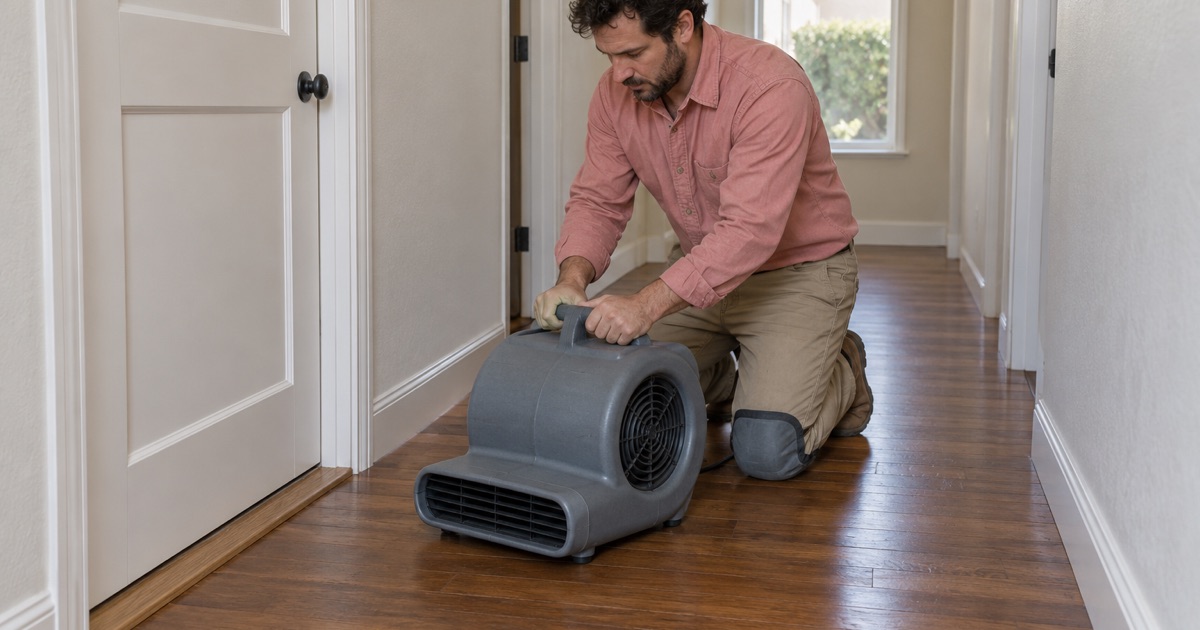
When the source is inside, the damage usually has edges. A leak under a kitchen sink spreads through the boards nearest it, wicks along the grain and slows down where the floor can dry out. Mapping those edges with a wood moisture meter tells us where damaged flooring ends and sound flooring begins, and that line is what a fair repair quote is built on.
That is why we rarely open a water job in this city by talking about the whole house. A floor that runs continuously through a living room, hall and bedrooms can often be repaired in the wet room alone, with the finish blended at a natural break such as a threshold. The goal is to replace what the water ruined and leave alone everything it never reached.
Looking for wood-flooring closer to Palos Verdes Estates? See Wood-Flooring in Palos Verdes Estates.
Where Water Usually Reaches a Floor Indoors
Most water-damaged wood floors we inspect tell a similar story: a fixture, fitting or seal that failed slowly. The boards react before anyone notices a puddle. Cupping, where board edges rise above their centers, is the most common early sign, and crowning or buckling can follow if the wood stays wet or gets sanded flat before it has dried.
Kitchens, Laundry Rooms and Bathrooms
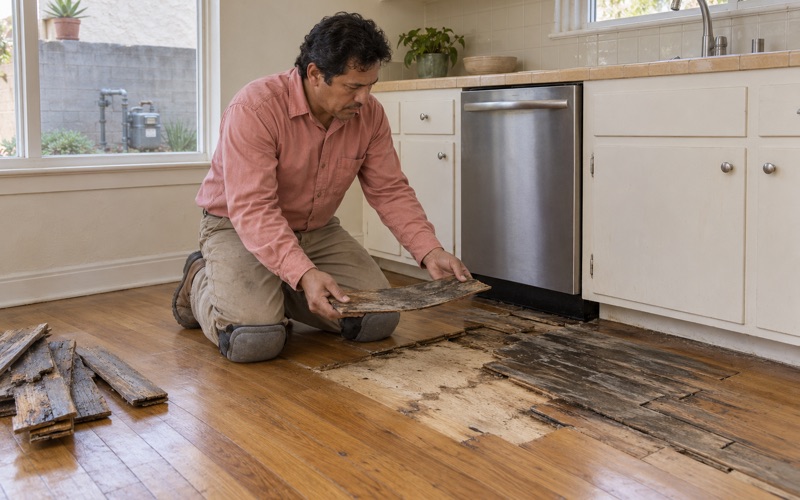
Dishwasher supply lines, refrigerator ice-maker lines, washing machine hoses and toilet wax rings are the usual culprits. Each sits against or near the floor, and each can leak for weeks behind a cabinet toe kick or under a vanity before anything shows. By the time boards lift, the subfloor beneath them has often taken on water as well.
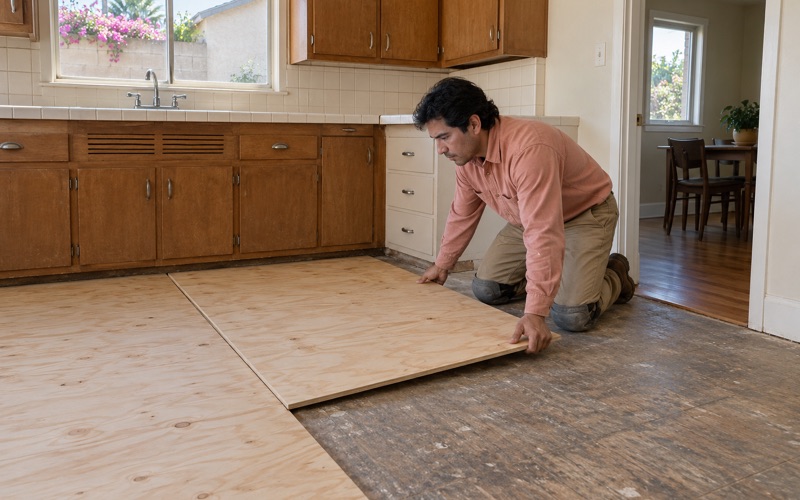
We pull the baseboard or shoe molding closest to the fixture, check the boards and then check what lies under them. If a plywood subfloor or board subfloor has softened or delaminated, the finish floor cannot be repaired properly on top of it. That part of the work is priced as its own line, so the owner can see where the money goes.
Water Heaters, Windows and Slow Roof Leaks
A water heater closet off a hallway, a window that never quite sealed, or a slow roof leak running down an interior wall can each damage a narrow band of flooring. Those strips often show gray or black staining along the board ends, where water sat longest. Dark stains that reach deep into the wood usually point to board replacement rather than sanding.
Pet accidents behave much like slow leaks. Pet urine stains soak into the same spot again and again, and they can blacken oak well below the surface. We test a stained area before quoting a sand and refinish, because promising that a stain will sand out and then finding it runs through the board is how a small job turns into a dispute.
When One Home Sits Above Another
Where one household lives above another, a leak upstairs can reach a ceiling below and a wood floor above at the same moment. Those jobs need the source fixed by a plumber before we set new boards. They also need the upstairs subfloor dried and read with a meter before flooring goes back down, because rushing that step traps moisture under brand-new wood.
Repairing Water-Damaged Boards Without Redoing the House
Many water-damaged wood floors can be repaired in part rather than replaced in full. On our jobs the work follows a fixed order: find the source, measure the moisture, cut out what failed, weave in matching boards and finish the repaired area so it reads as one floor. Skipping ahead in that sequence is the most common reason a patched floor fails a second time.
Tracing the Source and Recording Moisture
Before any board comes out, we confirm the leak has been repaired and then take readings. A pin or pinless wood moisture meter reads moisture content in the boards, and we compare wet areas against a dry reference in another room of the same home. If concrete sits underneath, a calcium chloride moisture test or an ASTM F2170 in-situ relative humidity test shows what the slab is holding.
Every reading goes onto a written record with photos, dated and tied to a room. That record matters when an insurance adjuster reviews a claim, because it shows where the water went and where it stopped. It also protects the owner later, since new wood installed over a damp subfloor can cup within months, and the readings show the floor was dry when we closed it up.
Weave-In Board Replacement
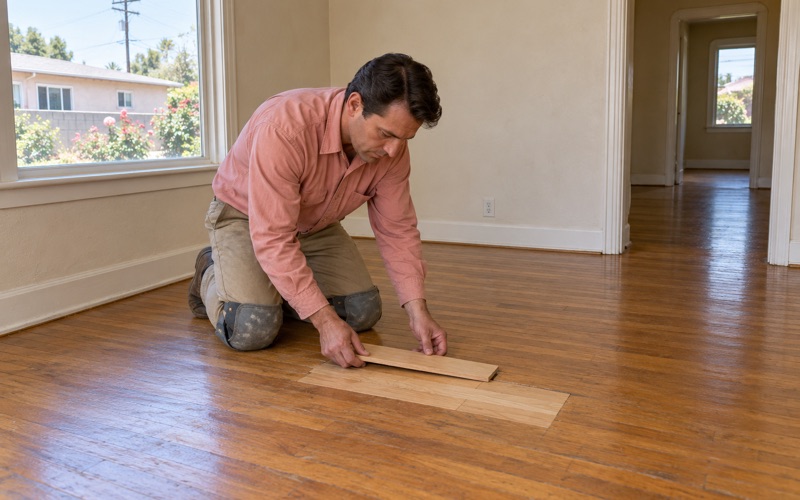
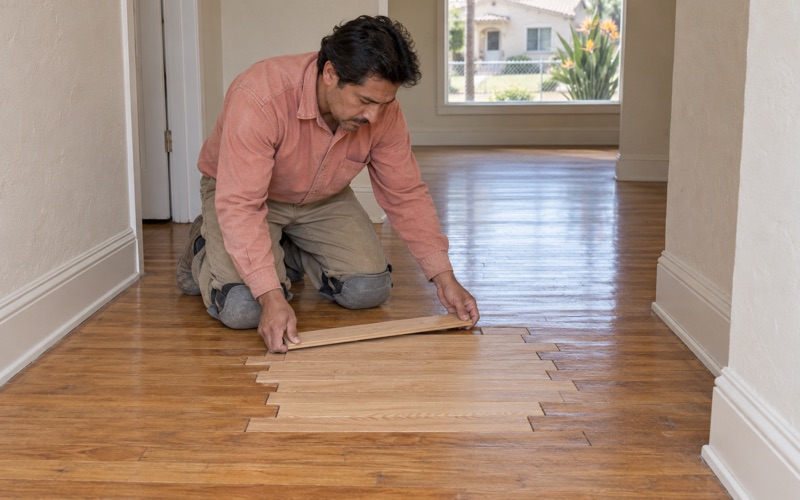
A weave-in repair removes damaged boards at staggered lengths and replaces them with new boards that interlock with the existing rows. It avoids the straight seam that makes a patch obvious from across the room. With oak strip flooring, matching width and species closely is usually possible, and we pull a sample board to confirm the match before ordering anything.
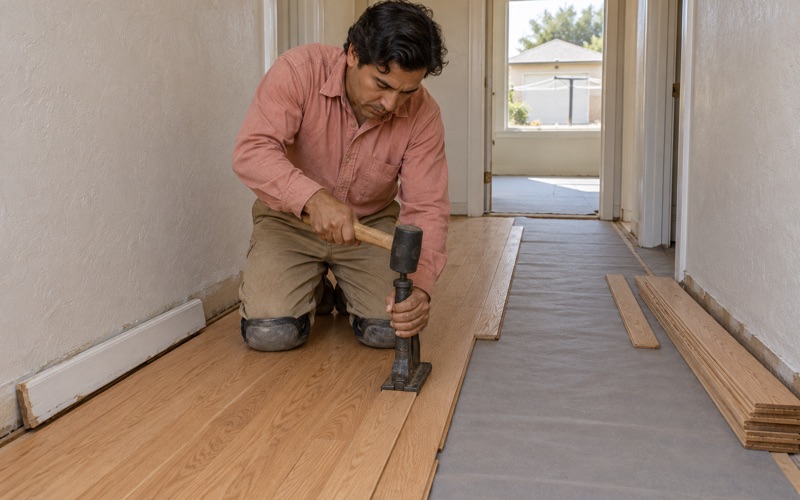
New boards need acclimation before they go in. They sit in the home until their moisture content lands close to the surrounding floor, following NWFA installation guidelines. Installing too early risks board gaps in the dry months or crowning later, and a repair that stands out a year after the job is not something anyone wants to pay for twice.
Blending the Finish
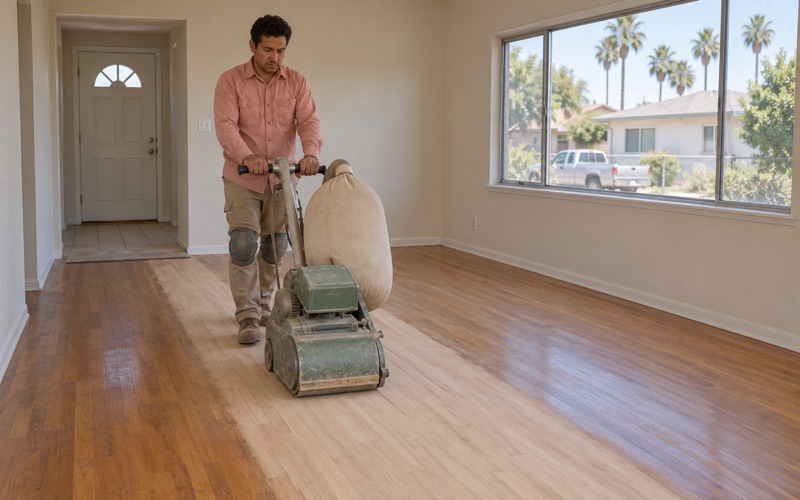
Once the new boards are down, the repaired area is sanded through a grit sequence and finished. Sometimes the whole room is sanded so color and sheen match wall to wall; sometimes a screen and recoat across the room is enough to tie old and new together. We explain which one the floor needs and why, and we price both when the choice is close.
Finishes come from waterborne polyurethane, oil-modified polyurethane or hardwax oil products that comply with SCAQMD Rule 1113 and its 275 g/L limit for wood coatings. The South Coast Air Quality Management District is the air agency for all of Orange County, so those limits apply here just as they do across the region. The sheen level is matched to what is already on the floor.
Planning Floor Work in Los Alamitos
Los Alamitos was incorporated in March 1960, and its housing peaked in that same decade: census figures count 1,302 units built in the 1960s, or 28.2 percent of the total. Overall, 70.5 percent of the city’s housing units predate 1980. Homes and apartments from those years can carry several layers of flooring history, and we plan for that before a quote is final.
Older Units and Lead-Safe Practice
Homes and rental units built before 1978 are covered by the EPA Renovation, Repair and Painting rule when work disturbs painted surfaces, which on a floor job usually means baseboards, thresholds and door casings. We follow lead-safe work practices on those jobs, with containment and cleanup to match. We ask for the year built on the first call so the plan is right from the start.
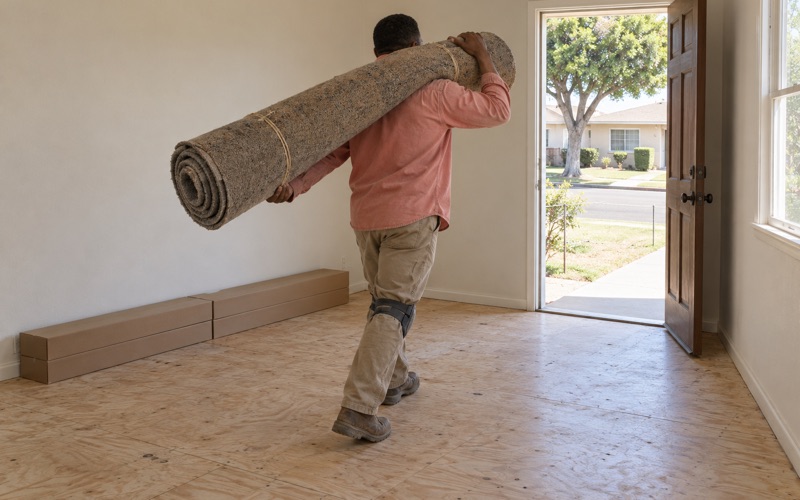
Older layers raise a second question. Nine-inch vinyl squares, known in the trade as 9x9 asbestos floor tile, and the black mastic beneath them are treated as a possible asbestos issue before anything is sanded or scraped. SCAQMD Rule 1403 governs asbestos work in the air basin, and an asbestos survey comes first whenever those materials turn up under a floor.
Renters, Owners and Written Scopes
Renters occupy 57.6 percent of the occupied housing units in Los Alamitos, with owners in the other 42.4 percent. That split means a floor job here often involves two parties: a tenant who lives on the floor and an owner or manager who pays for it. A written scope listing rooms, square footage and line items keeps both of them working from the same facts.
For a landlord, that estimate and the invoice that follows are documents to keep with a unit’s records between tenancies. For a seller, a room-by-room scope noting what was repaired and what was left untouched gives a buyer something concrete to read. Floors with a slope or a bounce are noted separately, since we trace those to the subfloor and framing before pricing any new finish floor.
City Review and Scheduling
Questions about whether a particular job needs city review go to the City of Los Alamitos Development Services Department, whose Building and Safety Division runs an online Building Permit Center. Its walk-in counter keeps hours of 7:30 a.m. to 12:30 p.m., Monday through Thursday. We raise that question during the estimate rather than after work has started.
Weather matters less than plumbing in this city’s floor work, but it still shapes the schedule. The National Weather Service places Los Alamitos in its Orange County Inland forecast zone, CAZ554, served by the San Diego office. We watch that forecast when a job involves acclimating wood or curing a finish, and we time the work so boards and coatings are not fighting a humid stretch.
- 20+ Years of Wood Flooring
- Written Scopes and Estimates
- Free Estimates