Compton Wood Flooring brings more than 20 years of hands-on work to wood flooring in Hermosa Beach, and every job we take starts with one question: what actually happened in this room? A cupped board, a gray stain or a soft spot by a door each points somewhere different. We refinish, repair and install hardwood, but the diagnosis comes before any of that.
Close to the ocean, it is easy to assume the sea is the main threat to a wood floor. The water we are called about is usually far more ordinary: a supply line, a leaking window, a roof that let go during a storm, or a door left open to the rain. We check those sources first and write down what we find before a price goes on paper.
This page explains how we approach floors in a beach city where the rare, worst-case water appears on an evacuation map. It covers what that state map is for, what it cannot tell anyone about a floor, and how we assess a wet room before replacement is ever raised.
Wood Floors Near the Hermosa Beach Tsunami Hazard Area
What the 2021 State Map Shows
On March 22, 2021, the California Geological Survey released new Tsunami Hazard Area maps for Los Angeles County. In the survey’s words, the maps show how far inland a surge of seawater might go in a worst-case scenario. They use a thousand-year scenario as the baseline, which makes them a planning tool for rare events rather than a forecast for any season.
The modeled worst case is a magnitude 9.3 earthquake in the eastern Aleutian Islands, with surges reaching the Los Angeles coast in about six hours. The survey called the changes to the county’s earlier inundation map modest, with potential upgraded in some areas and downgraded in others. Its own release named Alamitos Bay, Marina del Rey and the ports among the increased areas.
Homes a Block East of The Strand
Hermosa Beach is one of the three Beach Cities of the South Bay, bordered by Manhattan Beach to the north and Redondo Beach to the south and east. A Los Angeles Times report from March 2025 said the expanded hazard area here now covers homes a block or so east of The Strand, the path that runs along the beach.
The same report described the hazard area in Manhattan Beach as essentially limited to the beach and pier on the coastal side of The Strand. That contrast comes from a newspaper account, not from our own reading of the map, and we have not checked the map for any address. We leave the question of where a particular house falls to the official map and the city.
What a Planning Map Does Not Decide
The survey tied its maps to roads and landmarks so local officials can communicate evacuation plans clearly. That is their purpose. A planning map does not tell us whether a floor holds moisture, whether boards are cupping, or whether the subfloor underneath is sound, and it does not set the scope of any repair.
For a household, the map belongs in the family evacuation plan. For a floor, the questions stay the same ones we ask anywhere: where did the water come from, how long did it sit, and how far did it travel under the boards? We answer those with a meter, a camera and a look underneath, not with a map.
Looking for wood-flooring closer to La Palma? See Wood-Flooring in La Palma.
Where Floor Water Usually Comes From in a Beach House
Leaks Inside the Walls and Cabinets
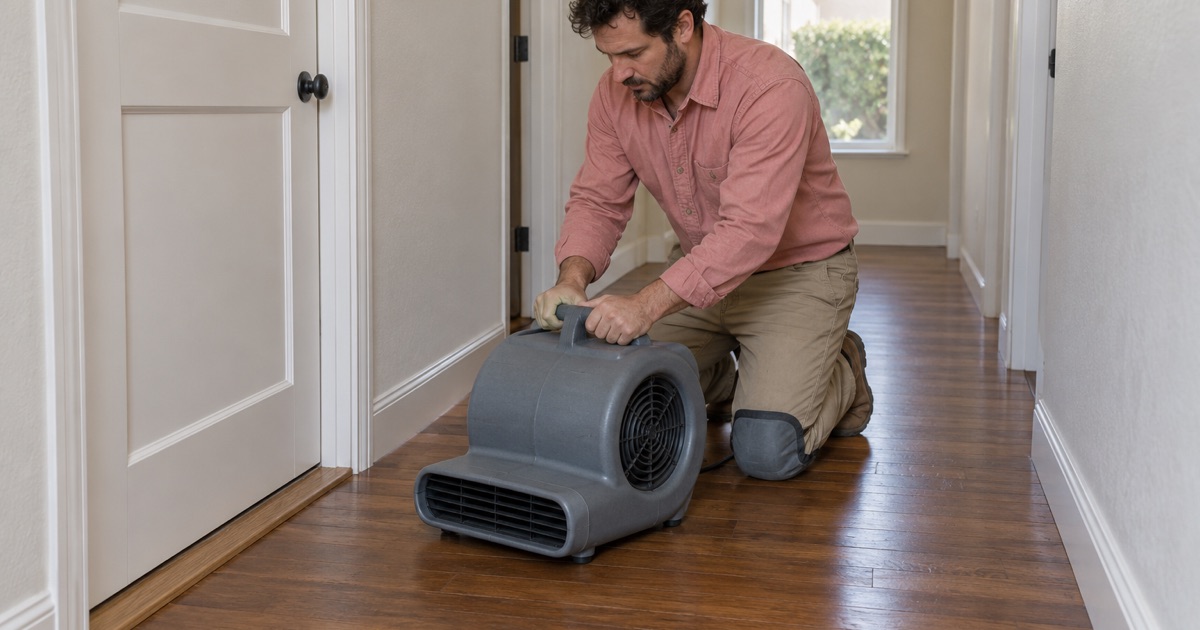
Most wet floors we see start behind a wall or under a fixture. A slow drip at a dishwasher, a toilet supply line, an ice maker or a washing machine can soak the underside of the boards for weeks before the surface shows a thing. By the time the edges lift, moisture has often spread well past the spot where the leak began.
We follow that water back to where it started before recommending anything. The damage gets photographed, and meter readings are logged room by room in a form an adjuster can work from, showing which areas read wet and which read dry. That record keeps the floor repair tied to the actual event, which helps when a claim and a plumbing fix are moving at the same time.
Storms, Doors and Windows
The other common source is weather finding an opening. Wind-driven rain at a sliding door, a failed window seal or a roof leak that works its way down a wall can wet a floor from the edge inward. The pattern it leaves is different from a plumbing leak, usually heaviest at the threshold or under the window and fading across the room.
The city’s internal point falls in the National Weather Service forecast zone named Los Angeles County Beaches. We check that zone’s forecast before scheduling sanding or finishing, because a coating needs steady conditions to cure and new boards need time to settle. A wet week is a good reason to move a finish date rather than rush it.
Saltwater Versus Fresh Water
Owners near the beach sometimes ask whether seawater would be handled differently from a burst pipe. It would be, since salt stays behind in wood and subfloor after the water itself dries out, so drying alone does not finish that job. In practice, the water we are called about is almost always fresh water from a leak or rain, and that is where our assessment begins.
We would rather be straight about the odds. The state maps model a thousand-year event, and nothing here suggests one is expected. A supply line that fails over a weekend is far more common, and it is exactly the kind of damage a careful, well-documented repair can often reverse without tearing out a whole room.
Assessing a Wet Floor Before Deciding to Replace
Moisture Readings Come First
We start with a wood moisture meter, reading the damaged boards and comparing them with a dry room elsewhere in the house. That comparison tells us how far above normal the moisture content has climbed and how far it has spread. Every reading is written down with its location, so we can show progress as the floor dries rather than guessing at it.
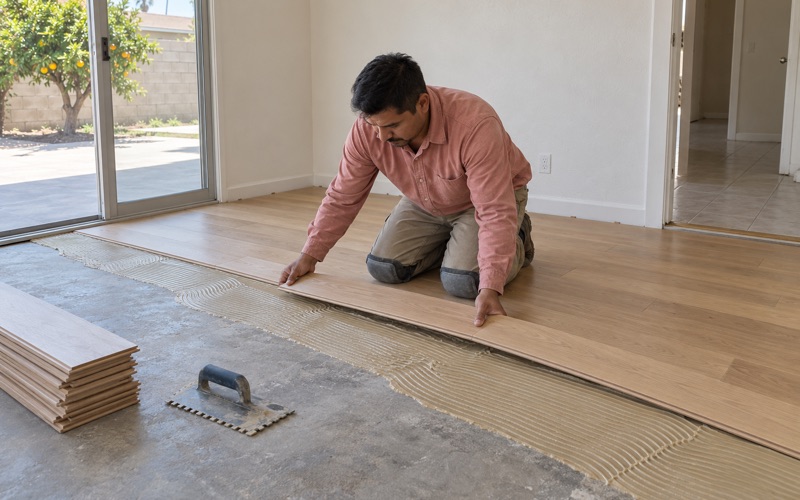
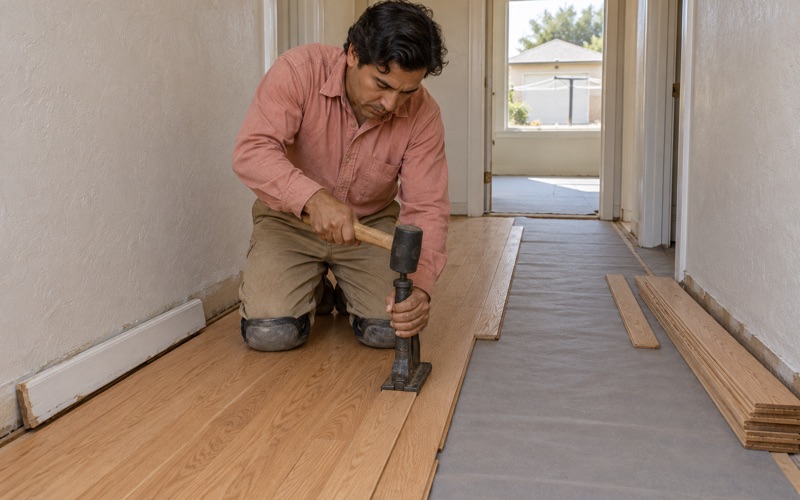
If any part of the job sits over concrete, we test the concrete too, using ASTM F2170 in-situ relative humidity probes or a calcium chloride moisture test. Material is not ordered until those numbers make sense. New boards then acclimate until their moisture content sits close to the floor they will join, following NWFA installation guidelines.
Cupping, Crowning and Buckling
Cupping, where board edges sit higher than the centers, usually means moisture reached the wood from below. Sanding a cupped floor too early flattens the edges, and when the boards dry they settle into crowning with the centers high. Buckling, where boards lift off the subfloor entirely, points to a larger volume of water or a missing expansion gap.
Patience saves floors here. Many cupped floors flatten substantially once the source is fixed and the wood returns to normal moisture, so we would rather monitor for a few weeks than sand into a problem. When the readings settle, we can say honestly whether a screen and recoat, a full sanding or a partial replacement is the right call.
Board by Board, Then the Framing
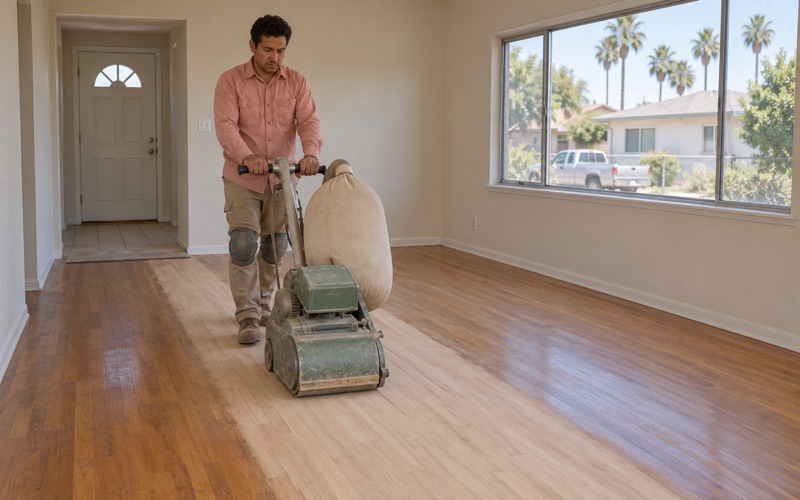
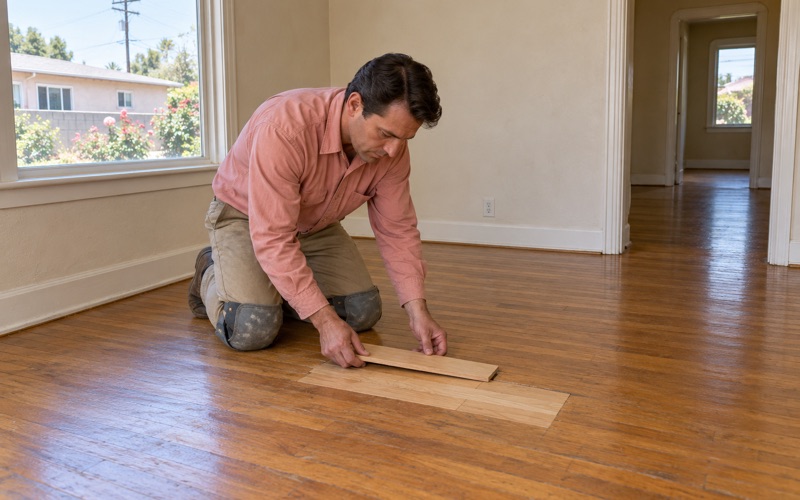
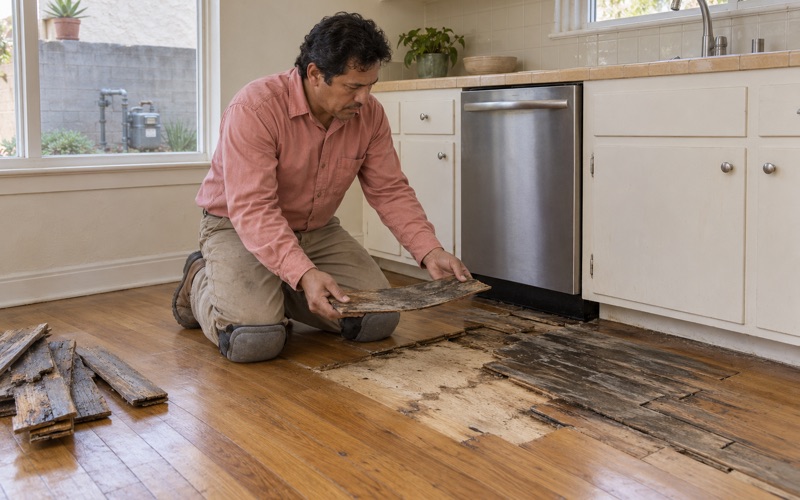
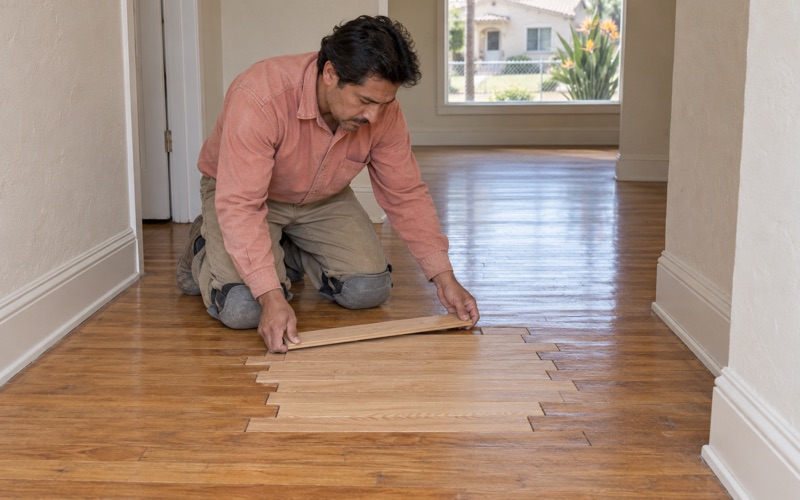
We judge the damaged area one board at a time instead of pricing the whole room as lost. Boards that are stained through, split or delaminated come out, and matching stock is woven into the surrounding field so the repair follows the grain. Wide plank and herringbone pattern floors take more care, but the same weave-in repair method applies.
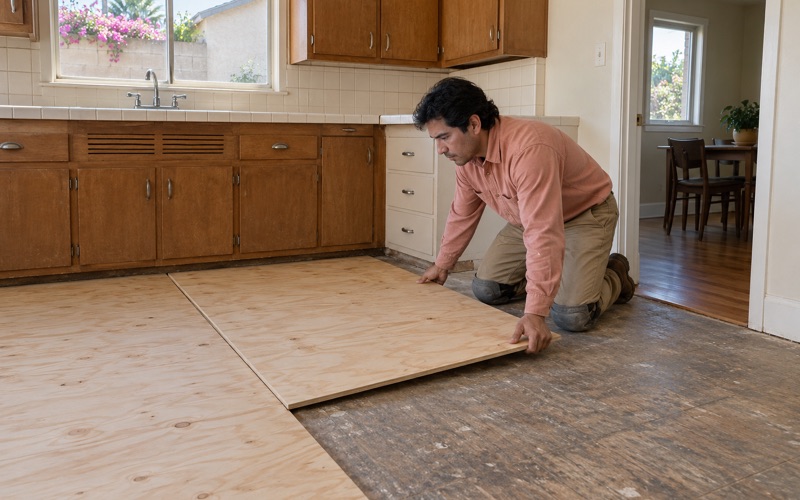
A soft spot after a leak can mean the plywood subfloor absorbed water or a floor joist has been affected underneath. We trace sloping or bouncy areas to the subfloor and framing before a finish floor is priced, and we write down what we found. That way the repair plan rests on evidence rather than on whatever is visible from the top.
Planning Floor Work in Hermosa Beach
Older Houses, Lead and Asbestos
Census figures put 70.5 percent of the city’s housing units before 1980, and 11.2 percent before 1940. For homes built before 1978, we follow lead-safe practices under the EPA Renovation, Repair and Painting rule, containing dust from painted baseboards, shoe molding and thresholds before any sanding starts. The plan for the floor waits until containment is in place.
Older floors were often covered with 9x9 tile or sheet goods set in black mastic at some point. We treat that kind of tile and adhesive as a possible asbestos question before anything is sanded or scraped, and an asbestos survey comes first when the materials warrant it. SCAQMD Rule 1403 governs how that work is handled in this region.
Finishes Within the Air District Limit
Hermosa Beach falls within the South Coast Air Quality Management District, where SCAQMD Rule 1113 caps wood coatings at 275 g/L of VOC. We choose from waterborne polyurethane, oil-modified polyurethane and hardwax oil finish products that meet that limit. Sheen level is part of the conversation too, since a lower sheen hides the sand that inevitably gets tracked in from the beach.
Written Scopes, Stairs and the City
Every estimate lists what we found, what we plan to do and why, room by room. That paper helps an owner compare bids, keep a record for a future sale, or give a landlord something clear to use at move-out. For work that opens framing, we suggest a call to the City of Hermosa Beach Community Development Department before anything starts.
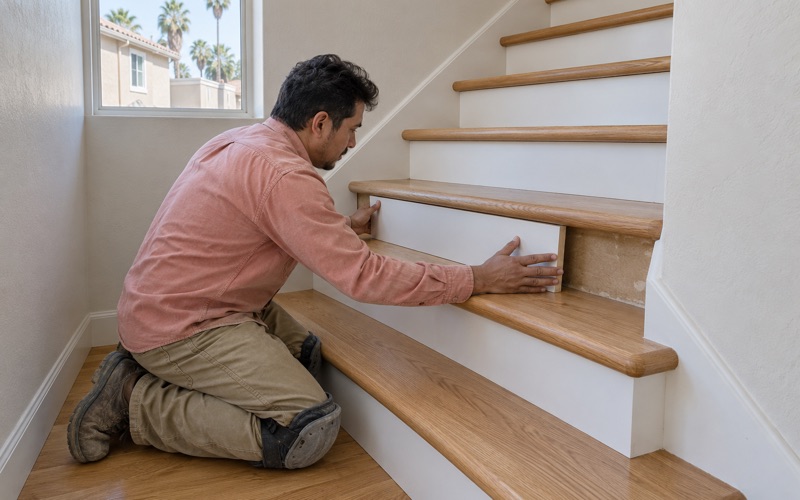
Stairs are priced per tread and riser rather than folded into a square-foot figure, because a staircase with worn nosings and water-stained treads takes far more hand work than an open room. Pricing them separately keeps the quote honest about where the time goes, and it lets an owner repair the damaged floor now and schedule the stairs for later.
- 20+ Years of Wood Flooring
- Written Scopes and Estimates
- Free Estimates