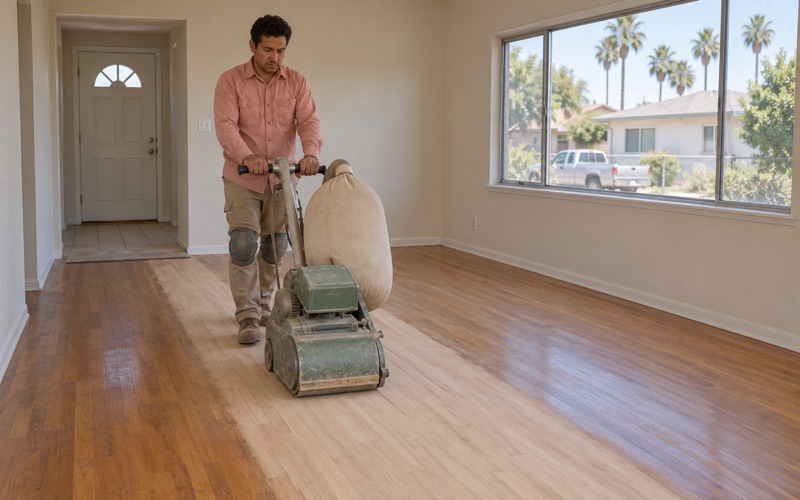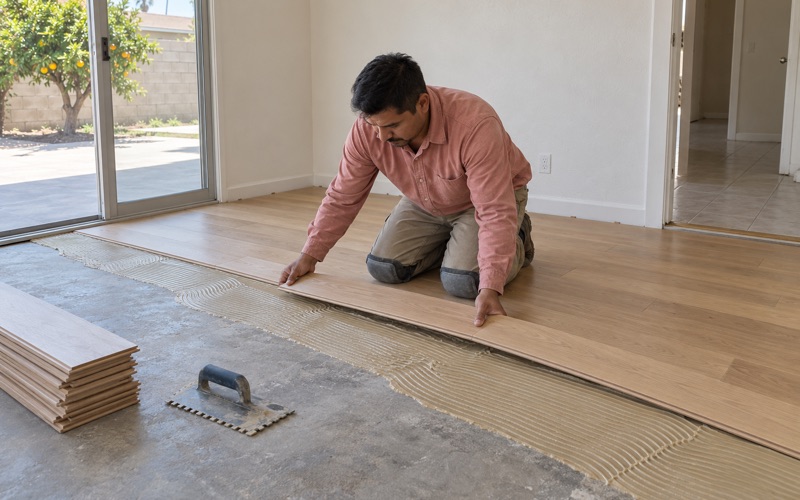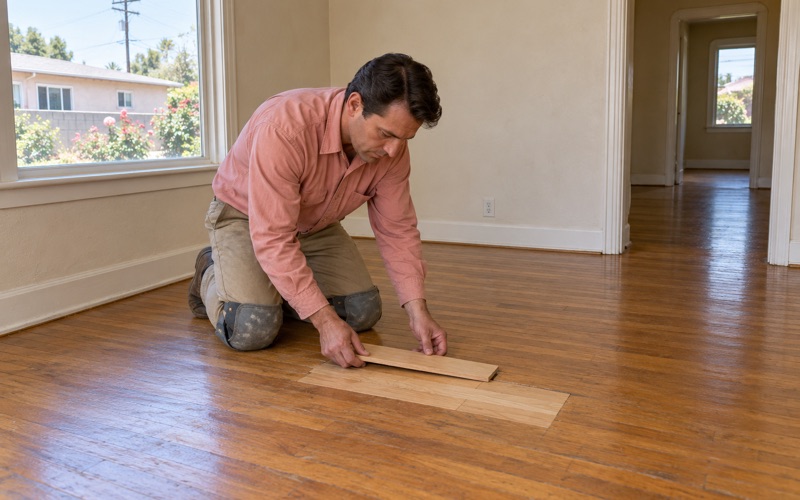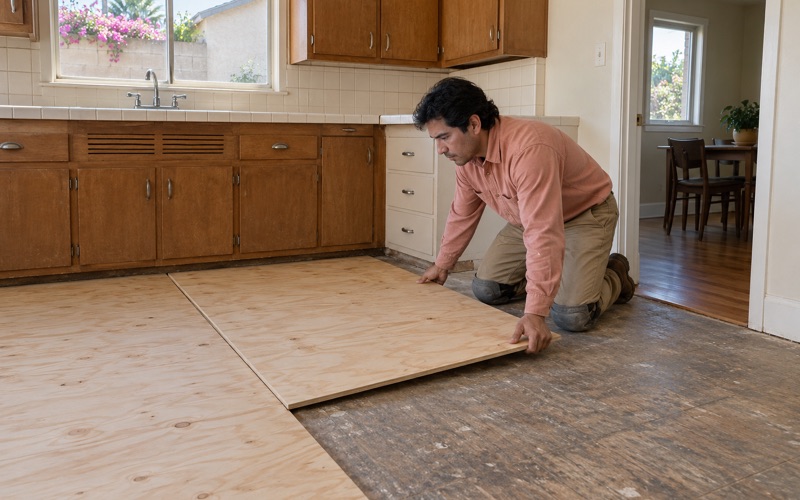
Compton Wood Flooring has handled wood-flooring in Hawaiian Gardens for more than 20 years, and a new kind of call is starting to come in from this small city. Alongside the older houses and duplexes we usually work in, newly built attached homes are going up for people to buy and own. This page is written for those buyers and owners, and for anyone weighing what to do with a floor that came from a builder.
A new home rarely needs rescuing, so our advice here is different from what we tell the owner of a house that has stood for sixty years. The questions are about what the builder actually installed, how to keep it in good shape, and which upgrades are worth the money. We answer them with measurements and written scopes rather than a sales pitch.
We install, sand, refinish and repair solid and engineered hardwood, and we plan each job around the building it sits in. That means checking moisture before any material is ordered, choosing finishes that are legal to apply in the South Coast air basin, and pricing stairs per tread and riser. The sections below cover what new owners tend to ask first.
New Homes for Sale on Hawaiian Avenue
An Infill Project on a Long-Vacant Site
The clearest example of new for-sale housing in the city sits at 21821 Hawaiian Avenue, south of Carson Street between Verne Avenue and Hawaiian Avenue. According to the city’s environmental filing, the project consolidates five existing residential parcels to build 18 condominium units for individual sale and ownership. It carries six fewer units than the General Plan maximum for the site.
The city described the land as a long-vacant site and the project as infill, meant to revitalize the area and enhance neighborhood property values. The filing was a Notice of Exemption received on February 28, 2019, under the project title 18-Unit Residential Condominium. For a city that incorporated in 1964 and covers under one square mile of land, that is a meaningful addition of homes built to be sold.
Where the Project Stands
At a Planning Commission meeting in August 2026, city staff reported the project as six detached buildings of three units each that had recently completed grading. That report comes from a summary of the meeting rather than the minutes themselves. We do not know the finishes, unit sizes or timing beyond that, and we will not guess at them here.
Staff at the same meeting also reported 21 approved ADU and JADU units in 2025. Together, those numbers show more new living space being added to a city where most homes are decades old. Each new unit eventually brings a set of floors that someone will live on, maintain and, at some point, want to change.
What Infill Construction Means for Floors
Infill homes are built on tight lots between existing buildings, and their floors go down near the end of a construction schedule. In any new building, framing, drywall mud, paint and concrete all release moisture as they dry. A floor installed into that environment can move more in its first seasons than one laid in a house that has been lived in for decades.
That is why we measure before we do anything to a new home’s floor. A wood moisture meter tells us the moisture content of any wood already in place, and wherever wood will go over concrete we test the concrete too, using an ASTM F2170 in-situ relative humidity test or a calcium chloride moisture test. The readings are written down and handed to the owner.
Looking for wood-flooring closer to Hermosa Beach? See Hermosa Beach Wood-Flooring.
Living With a Builder-Installed Floor
Knowing What Is Underfoot
The first thing a new owner should find out is what the floor actually is. Builders use a wide range of products, including solid hardwood, engineered wood, laminate, vinyl plank and carpet, and several look alike from a standing height. Each one is cleaned, repaired and replaced differently, so a correct answer early saves money later.
If the floor is engineered wood, the wear layer thickness decides whether it can ever be sanded and refinished, and how many times. Paperwork from the sale, a leftover carton or a close look at an exposed edge near a vent or threshold usually settles the question. When it does not, we can identify the product on a visit and tell the owner what it will and will not tolerate.
The First Year in a New Home
Wood responds to the air around it, and a newly finished home is still settling into a normal indoor range. Small gaps between boards may open during dry months and close again later, which is ordinary seasonal movement rather than a defect. Cupping, crowning or buckling is a different matter and usually points to moisture that deserves a closer look.
Hawaiian Gardens sits in the National Weather Service forecast zone for the Los Angeles County inland coast. Humidity inside any home shifts between seasons, and air conditioning, heating and open windows all play a part. Keeping indoor conditions steady through the first year gives a wood floor its best chance of staying flat and tight.
Daily Care That Protects the Finish
Most wear on a new floor comes from grit, not from heavy use. Mats at each entry, felt pads under chair and table legs, and regular dry mopping keep sand from grinding into the finish. Steam mops and heavy wet mopping are hard on wood and on many engineered products, because water finds its way into the seams.
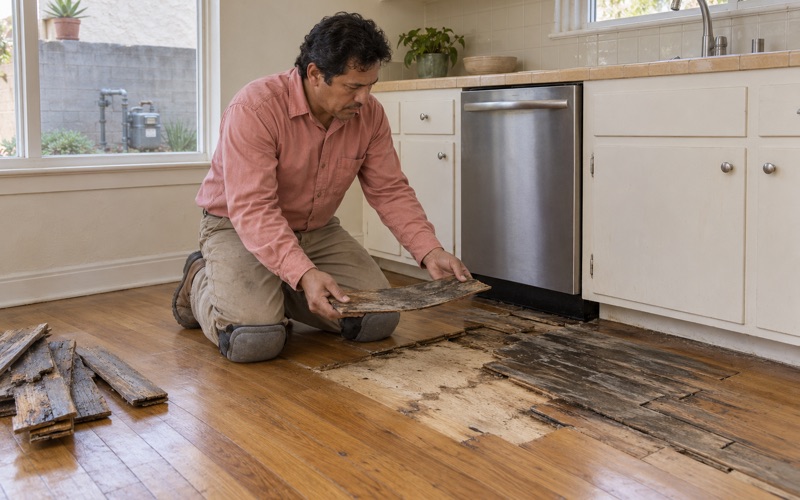
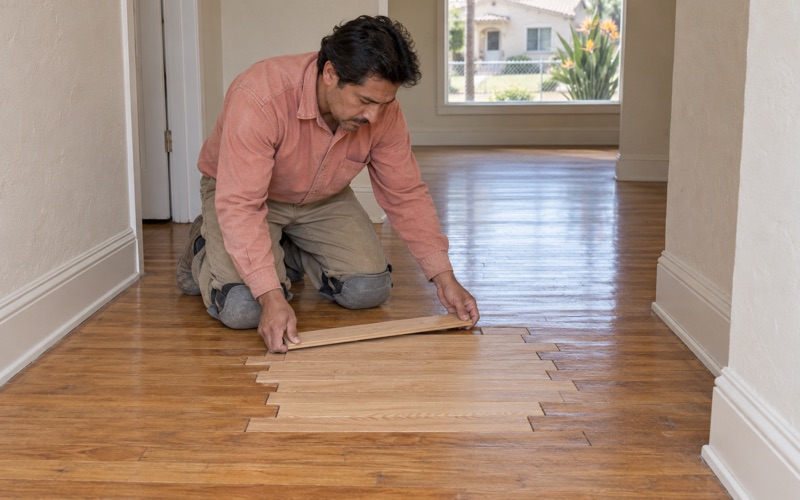
Pet claws, rolling office chairs and dragged furniture cause most of the early scratches we see. A light surface scratch in the finish can usually be handled with a screen and recoat, which adds a fresh coat without sanding into the wood. Deeper gouges may call for a board replacement, which is far easier if the owner kept a few spare boards from the original install.
Upgrading Floors in a Newly Built Condo
What to Change First
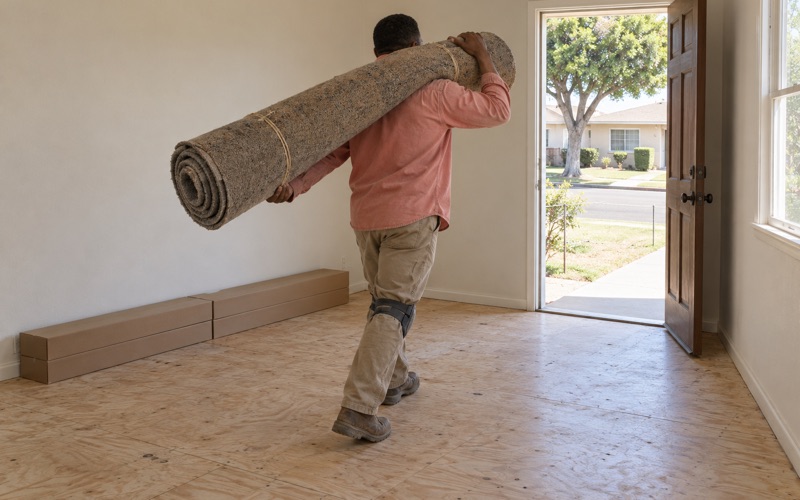
Many buyers of a new condominium want to replace carpet in bedrooms or living areas with wood, or swap a builder floor for something warmer. Before any of that, an owner in an attached building should read the association’s governing documents and look for any approval process for alterations. We do not assume what those documents say, and we ask to see them before quoting.
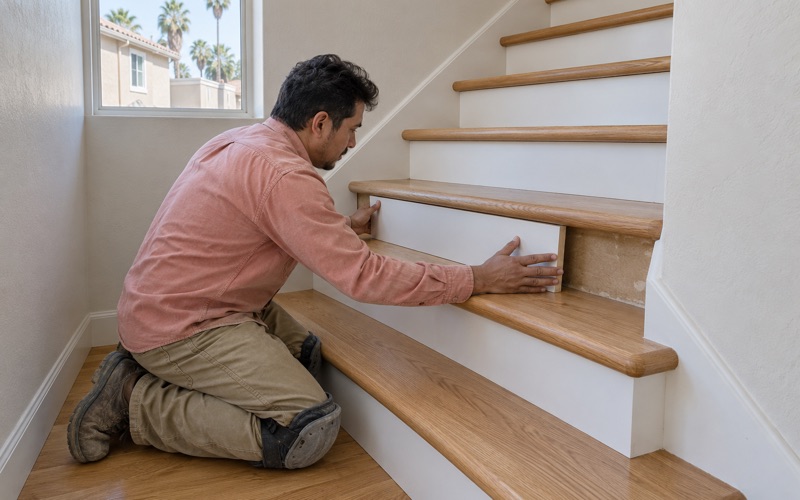
Where a unit has stairs, they are often the best first upgrade, since carpeted stairs wear quickly and are hard to keep clean. We price each stair tread and stair riser individually, including the nosing, so the cost of the stairs is clear apart from the rest of the floor. Transitions come next, with reducer strips and T-molding matched to the new floor’s height.
Choosing Wood for an Attached Home
In attached homes, engineered wood is a frequent choice because its engineered core construction resists seasonal movement better than a solid board of the same width. It can go down as a glue-down or floating installation depending on what sits beneath it. Solid hardwood in white oak, red oak or hickory is also possible where a nail-down installation over a wood subfloor is practical.
Species choice affects how the floor handles daily life. The Janka hardness rating gives a rough comparison, with hickory rating harder than the oaks, though the finish and good habits matter as much as hardness. We also confirm that any engineered or composite product meets the California formaldehyde limits in 17 CCR 93120.2, labeled CARB Phase 2 compliant or TSCA Title VI compliant.
Acclimation, Installation and Finish
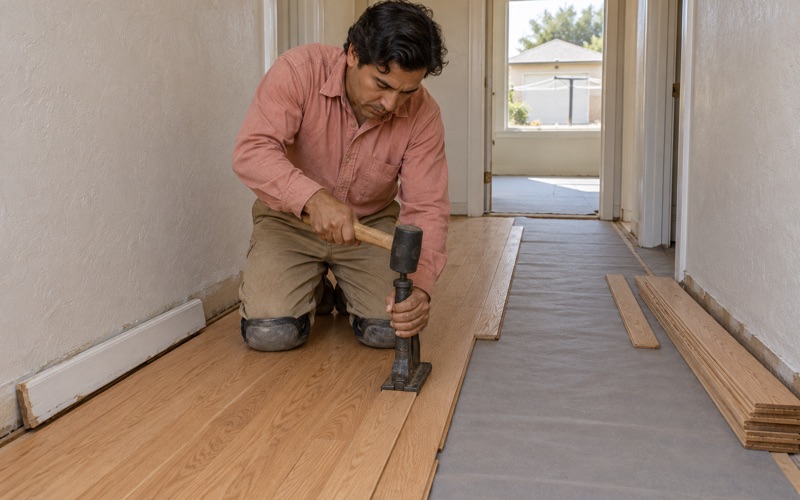
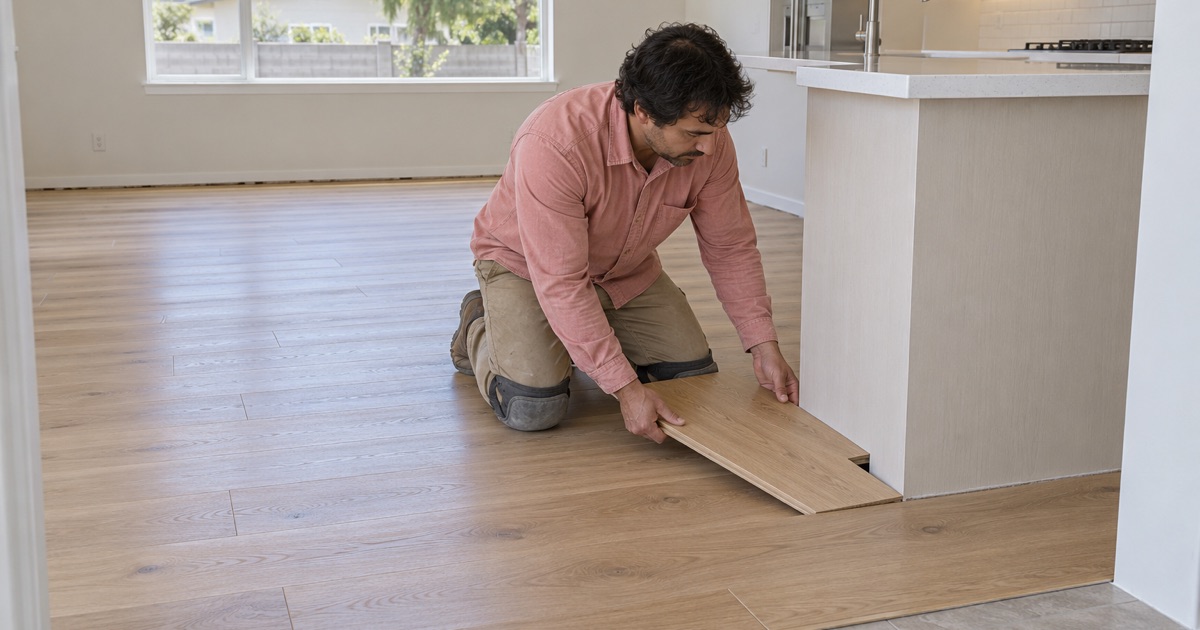
New flooring is delivered to the home and given time for acclimation before installation, following NWFA installation guidelines. We take readings of the new boards and of the subfloor, and we do not start until they fall within the range the manufacturer specifies. Leaving the correct expansion gap at walls and fixed objects is the other step that keeps a new floor from buckling later.
For site-finished floors, we choose products legal to apply under the 275 g/L VOC limit for wood coatings in SCAQMD Rule 1113, since Hawaiian Gardens is within the South Coast Air Quality Management District. Waterborne polyurethane dries quickly with low odor, which matters in a home that shares walls with neighbors. Prefinished hardwood skips on-site finishing entirely and shortens the time a room is out of use.
New Units Next to Hawaiian Gardens’ Older Homes
A Housing Stock Mostly From Before 1980
Census estimates put 73.7 percent of Hawaiian Gardens housing units as built before 1980. Only 367 units, or 8.9 percent, date from 2000 or later. A new condominium on Hawaiian Avenue therefore stands among neighbors that are mostly several decades older, many of them duplexes, small multi-unit buildings and single-family houses.
One-unit attached homes make up 12.0 percent of the city’s housing units, and buildings with two to four units account for another 17.9 percent. More than half of occupied homes, 56.2 percent, are rented. That mix means we can work in a newly built unit and a much older rental within the same few blocks, and the two call for different planning.
When the Home Is Older
In a home built before 1978, removing baseboard, shoe molding or door casing to reach a floor can disturb lead paint. We follow lead-safe work practices under the EPA Renovation, Repair and Painting rule on pre-1978 housing, containing and cleaning up dust as we go. None of that is needed in a brand-new unit, which is one reason the two kinds of jobs are priced differently.
Older homes can also hide 9x9 asbestos floor tile or black mastic beneath later coverings. We treat either one as a possible asbestos question and stop to address it properly before anything is sanded or scraped. In older houses we also trace any sloping or bouncy floor to the subfloor and framing before we price a new finish floor.
Written Scopes for Every Owner
Whether the home was finished last year or sixty years ago, the scope comes in writing, broken out by room and by task. New condominium owners get a record of moisture readings, materials and finishes they can keep with their home’s paperwork. Landlords get estimates and invoices they can use at move-out or before a housing-voucher inspection.
If a floor is ever damaged by water, we trace the leak to its source and document the damage with photos and moisture readings an insurance adjuster can use. That record is as useful in a new building as in an old one, since a failed supply line can wet a floor in any home. Our aim is a clear written plan before the first board is touched.
- 20+ Years of Wood Flooring
- Written Scopes and Estimates
- Free Estimates