Compton Wood Flooring brings more than 20 years of wood-flooring work to Artesia, and a large share of the calls we answer here start with water. A slow drip under a sink, a dishwasher hose that let go, or a storm that pushed rain past a threshold can each leave boards cupped, stained or loose. We handle installation, sanding, refinishing and repair, but this page is mostly about what water does to wood and how we deal with it.
Our first step on any wet floor is finding where the water came from before we talk about boards. A floor that gets replaced while a fitting keeps weeping will fail again, and nobody wants to pay for the same room twice. We follow the stain back to its source, take moisture readings across the affected area and photograph what we find.
Those records matter when a claim is involved. We write down the readings, the dates and the extent of the damage in a form an insurance adjuster can actually use, so a homeowner or landlord is not left arguing from memory. Then we lay out the repair in writing, room by room, before any work begins.
What Zone X Means for Wood Floors in Artesia
Flood maps come up often in conversations about water-damaged floors, and Artesia has a clear statement on the subject. It is worth reading carefully, because the wording is more careful than the way it usually gets repeated. Knowing what the city’s own review says helps a homeowner think about where water is actually likely to come from.
What the City’s Flood Review Says
The city’s July 2010 General Plan environmental review states that Artesia has been designated on the Flood Insurance Rate Map as being in Zone X, which it describes as a Non-Special Flood Hazard Area. The review cited FEMA map panels 06037C1839F and 06037C1980F. Those panels were read in 2010, so they describe the city as mapped then rather than the status of any single address today.
The same section goes on to say that because the city is within Zone X, the purchase of flood insurance is not required. It then adds a sentence that often gets left out: structures within Non-Special Flood Hazard Areas are still at risk. The review also notes that the city participates in the National Flood Insurance Program anyway.
Coyote Creek and the Storm Drains
The review places Coyote Creek along the city’s eastern boundary and notes that it joins the San Gabriel River roughly 2.1 miles southwest of the city. It lists the San Gabriel River, Coyote Creek and the Artesia-Norwalk storm drain as the existing storm drain facilities in the area. Those channels are built to carry runoff away from streets and homes.
The city also has its own storm water management and discharge control ordinance, found in Municipal Code Title 6, Chapter 7. For a wood floor, the practical point is simple. The drainage network is designed for large volumes of runoff, while most water that ruins a floor arrives in far smaller amounts from much closer by.
Why a Lower-Risk Map Is Not a Dry Floor
A Zone X designation speaks to overflowing rivers and mapped flood hazards, not to what happens inside a kitchen or laundry room. We have never seen a supply line check a flood map before failing. For anyone weighing coverage for a specific property, the answer belongs with the current map and an insurance professional, not with a flooring contractor.
What we can speak to is how wood behaves once water reaches it, and how quickly damage spreads when it goes unnoticed. That is where the rest of this page focuses. The difference between a board repair and a full room replacement is often a matter of days, and sometimes hours.
Looking for wood-flooring closer to Lomita? See Lomita Wood-Flooring.
Where Water Actually Reaches Floors in Artesia Homes
Most of the wet floors we open up were soaked by something inside the walls or beside the cabinets. Artesia’s housing stock is older than many people realize, and older plumbing tends to fail quietly. Knowing the common sources makes it easier to catch a leak while the damage is still limited to a few boards.
Pipes, Appliances and Fixtures
Census figures show that 76.2 percent of Artesia’s housing units were built before 1980. That means a lot of original supply lines, drains and shutoff valves are still in service, along with decades of later fixes layered on top. A corroded fitting behind a toilet or a pinhole in a line under a sink can wet a floor for weeks before anyone sees a stain.
Appliances are the other frequent culprit. Dishwashers, refrigerator ice-maker lines, washing machines and water heaters all sit close to floors, and a failed hose can release a great deal of water in a short time. We look under and around each of these whenever cupping appears near a kitchen or laundry area.
Rain at the Door
The city’s review describes Zone X areas as not in immediate danger from overflowing rivers or hard rains, yet a heavy storm can still find a way indoors. Water driven against a sliding door, a worn threshold or a low entry can creep under the first row of boards. It usually shows up as dark edges and lifting near the doorway.
Artesia falls within the National Weather Service forecast zone for the Los Angeles County inland coast. A door seal that looked fine through a long dry spell can still fail during the first hard rain that follows it. We check thresholds, weather stripping and the grade outside a door whenever damage starts at an entry.
Signs to Watch For
Early warning signs are easy to miss because they develop slowly. Boards that start cupping, with edges higher than their centers, are often reacting to moisture from below or from one side. Gaps that close up, finish that turns cloudy, or a musty smell near a cabinet base are all worth a closer look.
If a floor has already buckled or lifted away from the subfloor, the water has usually been there for some time. Shutting off the source and calling early gives the wood the best chance of recovering. The longer boards stay wet, the more likely they are to need replacement rather than drying and refinishing.
Drying and Repairing Water-Damaged Wood
Once the source is stopped, the job becomes one of measurement and patience. Wet wood cannot be judged by eye, and rushing a repair is the most common way a water-damaged floor ends up failing twice. We work from readings, not guesses, and we explain each reading to the owner as we take it.
Moisture Readings Before Any Decision
We use a wood moisture meter to map the moisture content across the damaged area and into the dry boards around it. Those readings show how far the water traveled, which is often well beyond the visible stain. Where a concrete slab sits under the floor, we test the concrete as well, using an ASTM F2170 in-situ relative humidity test or a calcium chloride test.
Every reading gets recorded with its location and date. That record tells us when the wood has returned to a normal range and is ready for work. It also gives an adjuster a clear picture of the damage, and it gives the owner a written history if questions come up later about the repair.
Cupping, Crowning and Buckling
Cupped boards sometimes flatten on their own as the wood dries, which is why we avoid sanding too early. Sanding a cupped floor before it dries can leave the boards crowned, with centers higher than edges, once the moisture finally leaves. Waiting for stable readings protects both the wear layer and the final look of the room.
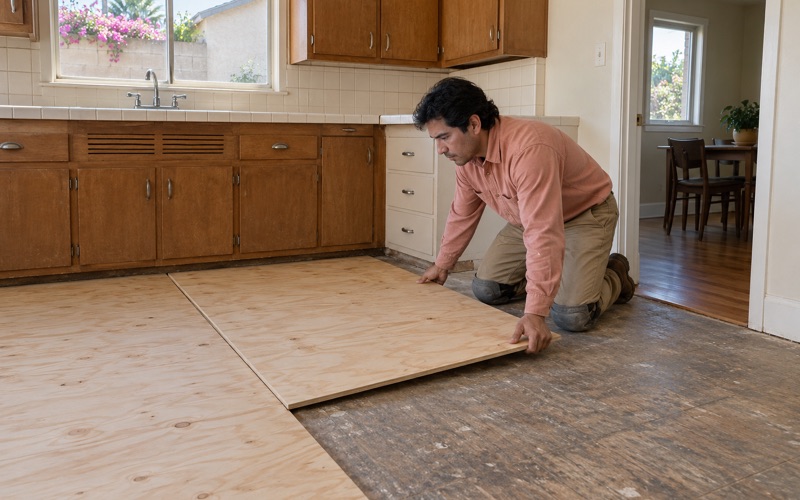
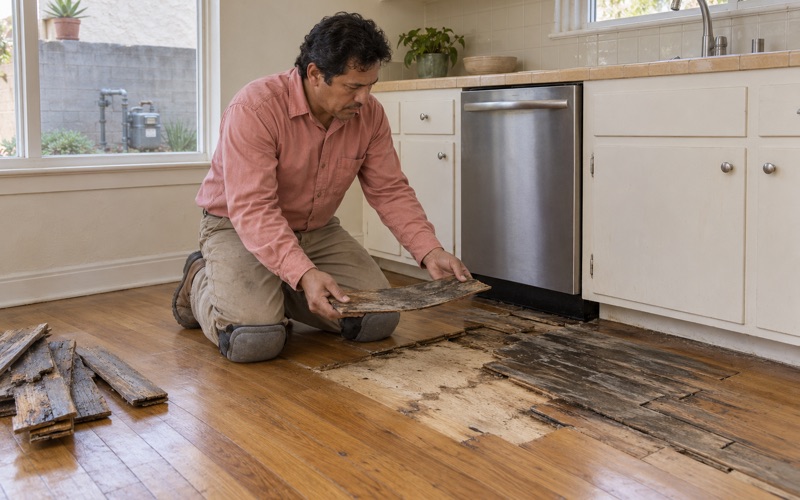
Buckled floors are a different case, since the boards have pulled away from the nails or adhesive holding them down. Those sections usually come out, and we inspect the subfloor underneath for softness, staining or mold before anything new goes in. A soft or damaged plywood subfloor gets repaired first, because new boards fastened over a weak base will not stay flat.
Weave-In Repairs and Refinishing
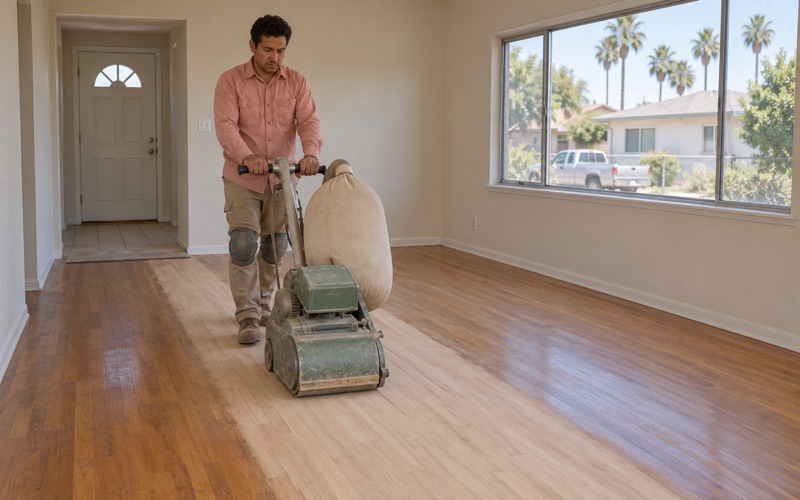
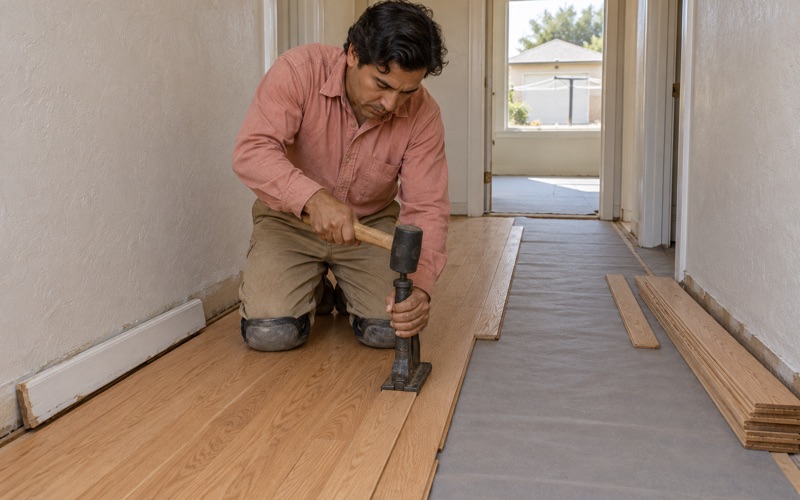
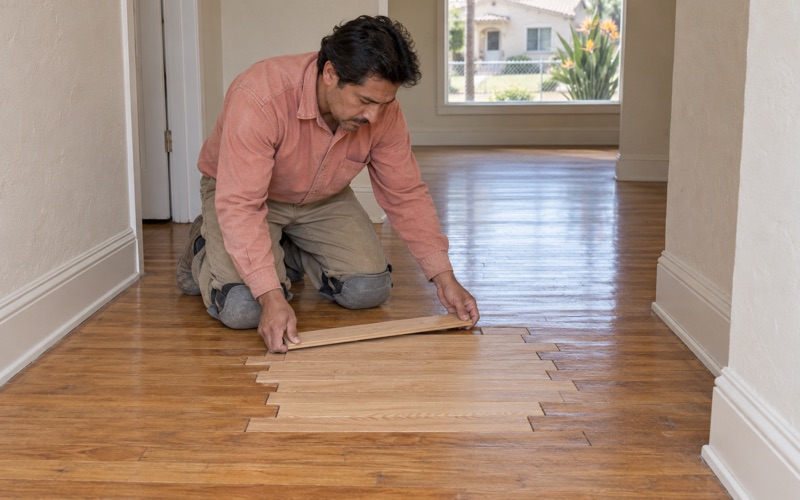
When only part of a room is damaged, we remove the affected boards and weave in replacements so the repair blends into the surrounding floor. Matching species, width and grain direction matters more than people expect. After the new boards settle, the whole room can be sanded and finished so the patch does not stand out.
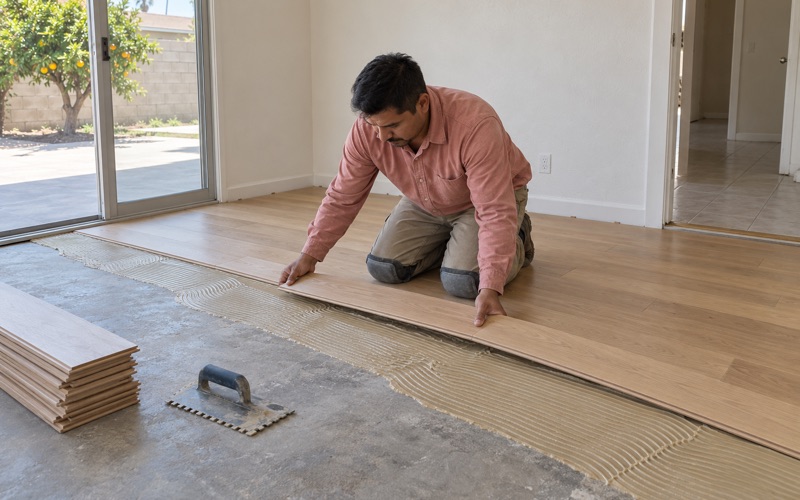
If the damage runs across most of a room, full replacement may make more sense than a patchwork repair. We give the owner both options in writing when both are reasonable, with the reasons behind each. The choice depends on the extent of the damage, the condition of the remaining boards and how long the room needs to stay usable.
Planning Floor Work in Artesia
Artesia is a compact city of about 1.62 square miles in southeastern Los Angeles County, bordered by Cerritos on three sides and Norwalk to the north. Its homes span every era from before 1940 to the last decade, and each era brings its own questions. A few of those questions shape almost every job we take on here.
Older Homes and Lead-Safe Practices
With so much of the city built before 1980, many homes date from before 1978, when lead-based paint was still in use. Removing baseboards, shoe molding or door casings to reach a damaged floor can disturb old paint. We follow lead-safe work practices under the EPA Renovation, Repair and Painting rule on pre-1978 houses, keeping dust contained and cleaned up.
Old floor coverings deserve caution too. Tile in the 9x9 size and the black mastic sometimes found under older floors can contain asbestos. When we find either under a water-damaged floor, we treat it as a possible asbestos question and stop to address it properly before anything is sanded, scraped or pulled up.
Finishes for the South Coast Air Basin
Artesia sits within the South Coast Air Quality Management District, which sets limits on the solvents in wood coatings. We choose finishes that are legal to apply here, working within the 275 g/L VOC limit for wood coatings under SCAQMD Rule 1113. Waterborne polyurethane is a common choice after a water repair because it dries quickly and has a low odor.
Oil-modified polyurethane and hardwax oil finishes are available in compliant formulas as well, and each gives a different look and wear pattern. We talk through sheen level, color and maintenance with the owner before the first coat goes down. A finish that suits the way a household actually uses a room tends to last longest.
Written Scopes for Owners and Landlords
Roughly half of Artesia’s occupied homes are rented, with 2,278 renter-occupied units counted against 2,235 owner-occupied ones. Landlords handling a leak between tenants often need clear paperwork. We provide written estimates and invoices that document what was repaired, which helps at move-out or before a housing inspection.
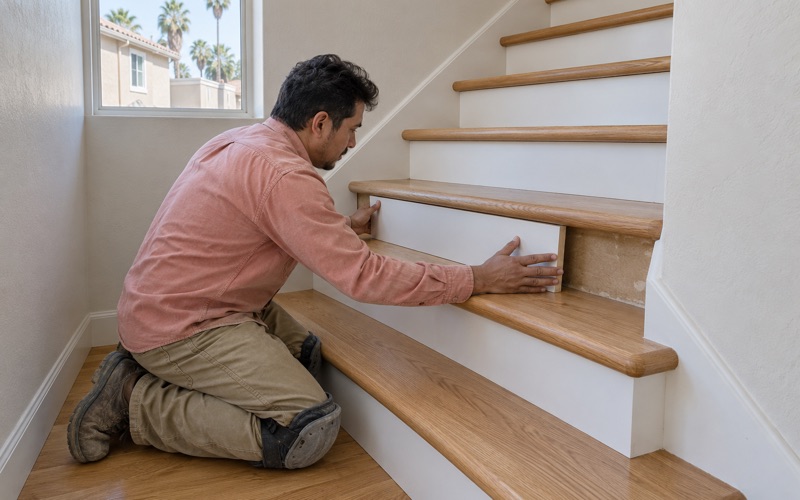
Homeowners get the same written scope, broken out by room and by task. Stairs are priced per tread and riser rather than folded into a square-foot figure, so each part of the job is easy to follow. Whether the work follows a burst supply line or a planned remodel, the paperwork should make the decision straightforward.
- 20+ Years of Wood Flooring
- Written Scopes and Estimates
- Free Estimates